
How to Improve Financial Close Processes Using JD Edwards
Month-end financial close is one of the most resource-intensive processes for organizations using JD Edwards EnterpriseOne.
Despite setting ambitious close targets, many finance teams continue to rely on manual reconciliations, spreadsheet-based reporting, disconnected workflows, and end-of-period verification, creating unnecessary delays, errors, and pressure on finance professionals.
The real challenge is not completing the same work faster but reducing the amount of work that remains within the close itself.
Modern financial close strategies focus on continuous verification, timely transaction processing, automated or streamlined reconciliations, and intelligent reporting to shift activities earlier in the accounting cycle.
When these practices are supported by the capabilities of JD Edwards ERP , including workflow automation, Orchestrations, integrity reporting, financial reporting, and integrated financial data, organizations can reduce manual effort, improve accuracy, shorten close cycles, and enable finance teams to focus more on analysis and decision-making.
Why Financial Close Processes Become Slow and Complex?
Financial close processes in JD Edwards become slower when manual activities, disconnected workflows, and end-of-period dependencies accumulate, increasing effort, delaying reporting, and reducing overall finance efficiency.
Common Bottlenecks in Traditional Financial Close
- Manual Reconciliations: Matching GL, subledger, inventory, and account balances manually consumes significant time and increases the risk of errors.
- Spreadsheet Dependency: Many JDE teams rely on spreadsheets outside JD Edwards ERP, creating duplicate work, inconsistent data, and version control issues.
- Late Journal Entries: Last-minute postings require additional reviews, adjustments, and validations before period close.
- Delayed Approvals and Cross-Department Coordination: Waiting for approvals, supporting documents, and business inputs slows the close across Oracle JD Edwards environments.
Business Impact of an Inefficient Close Process
- Delayed Reporting: Slow close cycles postpone financial statements and limit timely business insights from JD Edwards software.
- Higher Risk of Errors: Manual processing and repeated data handling increase reconciliation mistakes and reporting inaccuracies.
- Compliance Challenges: Delayed validations and incomplete audit trails make regulatory reporting and audits more difficult.
- Reduced Finance Productivity: Finance teams using the JD Edwards program spend more time gathering data than delivering strategic financial analysis.
Transform your JD Edwards environment with Saamsha Technologies. Our experienced consultants deliver implementation, upgrades, support, and optimization services that improve efficiency, reduce costs, and accelerate business growth.
How JD Edwards Improves Financial Close Processes?
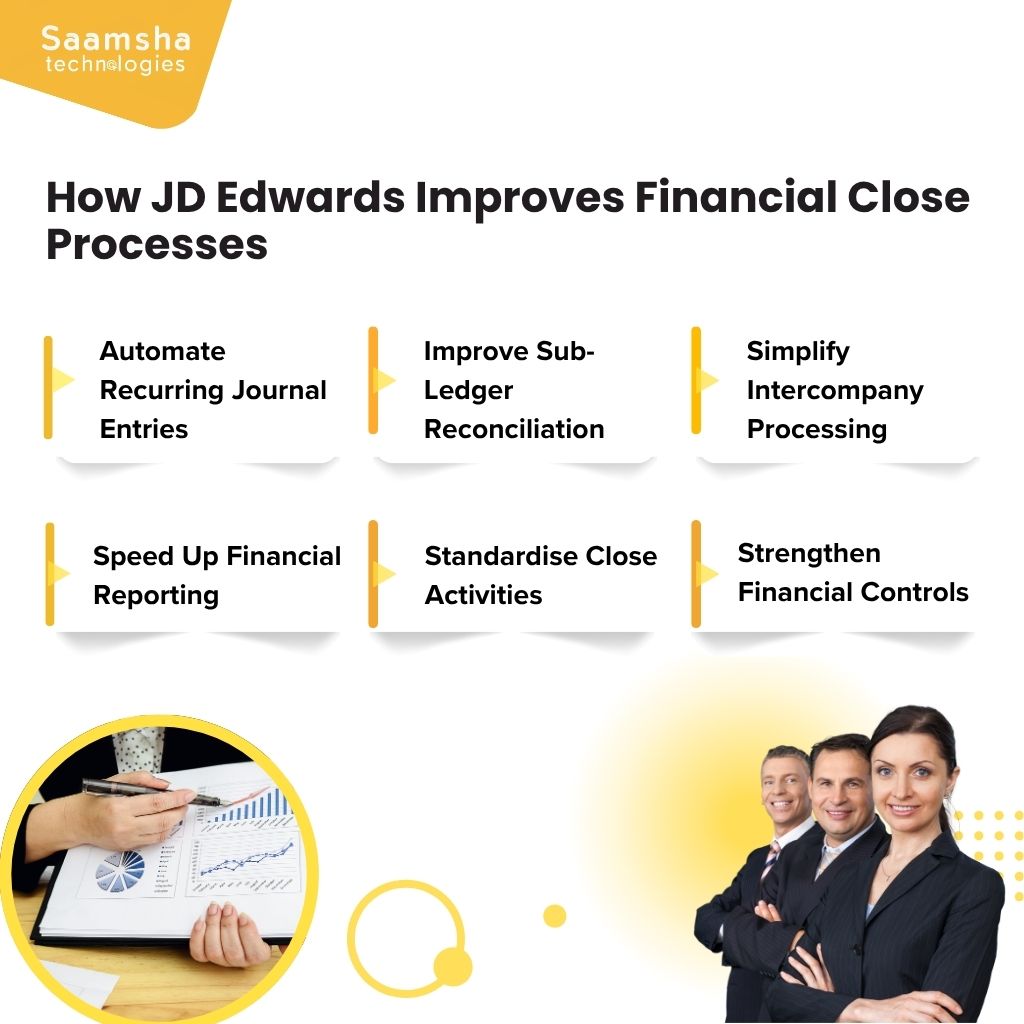
JD Edwards (JDE) can make the financial close process faster and more organised by reducing manual work, improving reconciliations and giving finance teams better control over close activities. Here are some key ways JD Edwards can improve the financial close:
- Automate Recurring Journal Entries: JDE can automate recurring accruals, allocations and reclassification entries. This reduces repetitive data entry and provides a clear audit trail showing how figures were calculated.
- Improve Sub-Ledger Reconciliation: Integrity reports or custom UBEs can identify differences between AP, AR, fixed assets and the general ledger before period-end and help teams address issues earlier.
- Simplify Intercompany Processing: JDE Intercompany Settlements can automatically create offsetting entries across companies and reduce the need to manually track balances in spreadsheets.
- Speed Up Financial Reporting: EnterpriseOne’s One View Reporting allows finance teams to create and refresh financial views without depending heavily on IT for report changes.
- Standardise Close Activities: Clear checklists, task owners, dependencies and deadlines can improve visibility and help controllers identify activities delaying sign-off.
- Strengthen Financial Controls: Regular access reviews and segregation-of-duties mapping can reduce close-related errors while supporting audit requirements. AI and GenAI tools can also assist with variance commentary and identifying unusual account movements.
Best Practices for Optimising Financial Close in JD Edwards
A well-optimized financial close in JD Edwards combines standardized processes, automation, and real-time financial visibility to reduce manual effort, improve reporting accuracy, and create a faster, more reliable close cycle.
Standardise Financial Processes and Workflows
- Create Consistent Close Procedures: Standardize checklists, approval workflows, and task ownership across departments to minimize delays, improve collaboration, and ensure every financial close follows a consistent process.
- Review and Simplify Close Activities: Regularly assess close tasks to eliminate low-value manual work and move routine activities outside the month-end cycle, allowing finance teams to focus on analysis and decision-making.
- Define Clear Close Responsibilities: Assign ownership for reconciliations, journal entries, approvals, integrity checks, and reporting activities so that each task has a clear owner and completion timeline.
Leverage Automation and Orchestrations
- Automate Repetitive Finance Tasks: Use Oracle JD Edwards Orchestrations to automate reconciliations, integrity checks, approvals, notifications, data validations and improve consistency while reducing manual effort.
- Reduce Reliance on Technical Teams: Self-service workflows enable finance users to complete routine tasks independently, improving productivity and minimising IT dependencies.
- Prioritise High-Volume Activities: Identify repetitive activities that follow consistent business rules and evaluate them for automation. This can include notifications, information retrieval, workflow steps, and other defined processes that support the financial close.
Monitor Performance Using Real-Time Financial Data
- Monitor Financial Activity Continuously: Use real-time dashboards and reports in JD Edwards software to identify reconciliation issues, unposted transactions, and exceptions before month-end.
- Support Faster Business Decisions: Continuous visibility helps organisations using JDE improve reporting accuracy, resolve issues sooner, and accelerate financial close cycles.
- Track Close Performance: Monitor reconciliations, exceptions, approvals, journal entries, and close timelines to identify bottlenecks and continuously improve financial close efficiency.
Simplify your ERP operations with Saamsha Technologies. From implementation and customization to managed support and upgrades, we help organizations achieve greater productivity, reliability, and operational excellence.
Final Thoughts
Optimizing the financial close in Oracle JD Edwards delivers measurable improvements in efficiency, accuracy, and financial control.
By reducing manual reconciliations, automating repetitive tasks, and replacing month-end validations with continuous financial verification, organizations can shorten close cycles while improving reporting quality and compliance.
Standardized workflows, real-time financial visibility, and intelligent automation also enable finance teams to spend less time gathering data and more time delivering strategic insights.
Rather than simply accelerating existing processes, businesses should focus on eliminating unnecessary manual effort.
Adopting a structured financial close strategy supported by JD Edwards capabilities can help organisations create a faster, more reliable, and future-ready finance function.
Take the next step with Saamsha Technologies. Connect with our Oracle JD Edwards experts to modernize your ERP, streamline business processes, and build a smarter, more efficient enterprise.