JD Edwards Managed Services helps organizations manage, optimize, and support ERP systems JD Edwards built on JD Edwards EnterpriseOne and JD Edwards World.
These systems power core business processes across finance, supply chain, manufacturing, and operations while requiring continuous stability, performance, and governance.
JD Edwards managed serves as a central ERP backbone in modern enterprises, integrating financial data, supply chain workflows, and operational processes. It enables consistent data visibility, reporting, and efficient enterprise-wide coordination.
Increasing system complexity, integration requirements, and 24/7 business dependency make in-house ERP management challenging.
Managed services provide proactive monitoring, skilled support, cost efficiency to ensure uptime, security, and uninterrupted business continuity performance reliability today.
At Saamsha Technologies, we deliver JD Edwards managed services with experienced consultants, flexible engagement models, proactive support, and strong implementation expertise.
What Are JD Edwards Managed Services?
JD Edwards ERP Software Managed Services is an outsourced model for managing and supporting ERP environments built on JD Edwards EnterpriseOne and JD Edwards World.
It covers end-to-end responsibilities, including CNC administration, database management, application support, infrastructure handling, upgrades, patches, and ongoing technical maintenance.
The scope ensures system stability, scalability, security, and performance optimization while reducing internal IT burden.
By leveraging expert resources, organizations can maintain continuous operations, improve efficiency, and focus on strategic business initiatives instead of day-to-day ERP management tasks.
Why Organizations Struggle with JD Edwards Management?
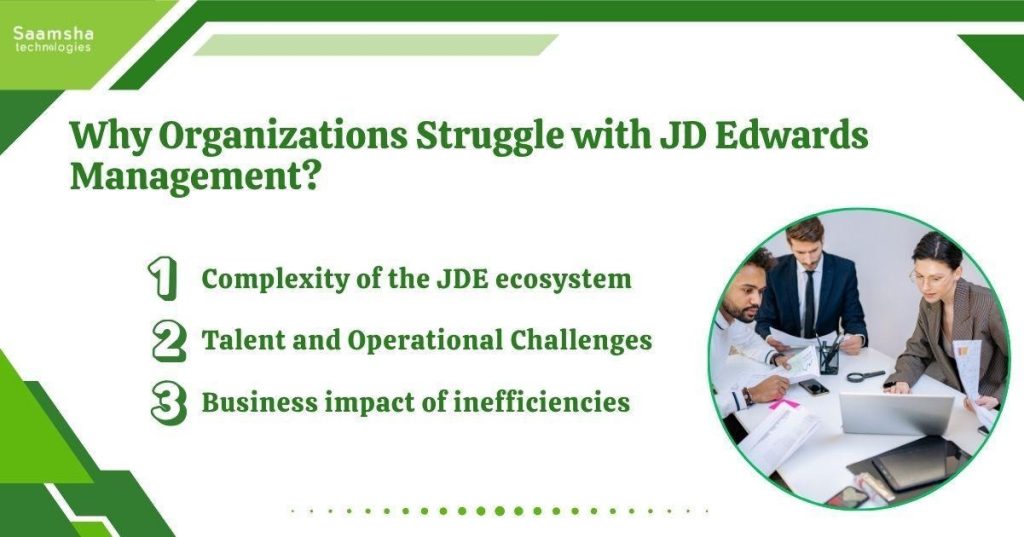
Supporting JD Edwards environments becomes increasingly difficult as systems grow in complexity, talent becomes scarce, and business demands rise faster than internal IT teams can keep up.
These challenges often lead to inefficiencies, higher costs, and operational risks that impact overall business performance.
Complexity of the JDE ecosystem
The ERP JD Edwards environment is built on a multi-layer architecture that includes applications, tools, databases, and multiple server components such as enterprise and HTML servers.
This layered structure increases flexibility but also adds significant complexity. Integration with third-party systems further complicates operations, requiring constant coordination and troubleshooting.
On top of this, Oracle’s continuous updates and enhancements demand ongoing monitoring, testing, and system adaptation to ensure stability and compatibility.
Talent and Operational Challenges
Organizations often struggle to hire and retain experienced JD Edwards professionals due to high demand and limited availability of skilled talent.
Maintaining 24/7 support coverage becomes costly and difficult, especially for global operations.
Over time, knowledge gaps emerge due to employee turnover, long leave periods, or retirements, leaving critical systems vulnerable and increasing dependence on a few key individuals.
Business impact of inefficiencies
These challenges directly affect business performance through system downtime, delayed reporting, and reduced operational productivity.
Internal IT teams become overburdened with reactive issue handling, leaving them unable to focus on strategic initiatives, which further slows digital transformation and business growth.
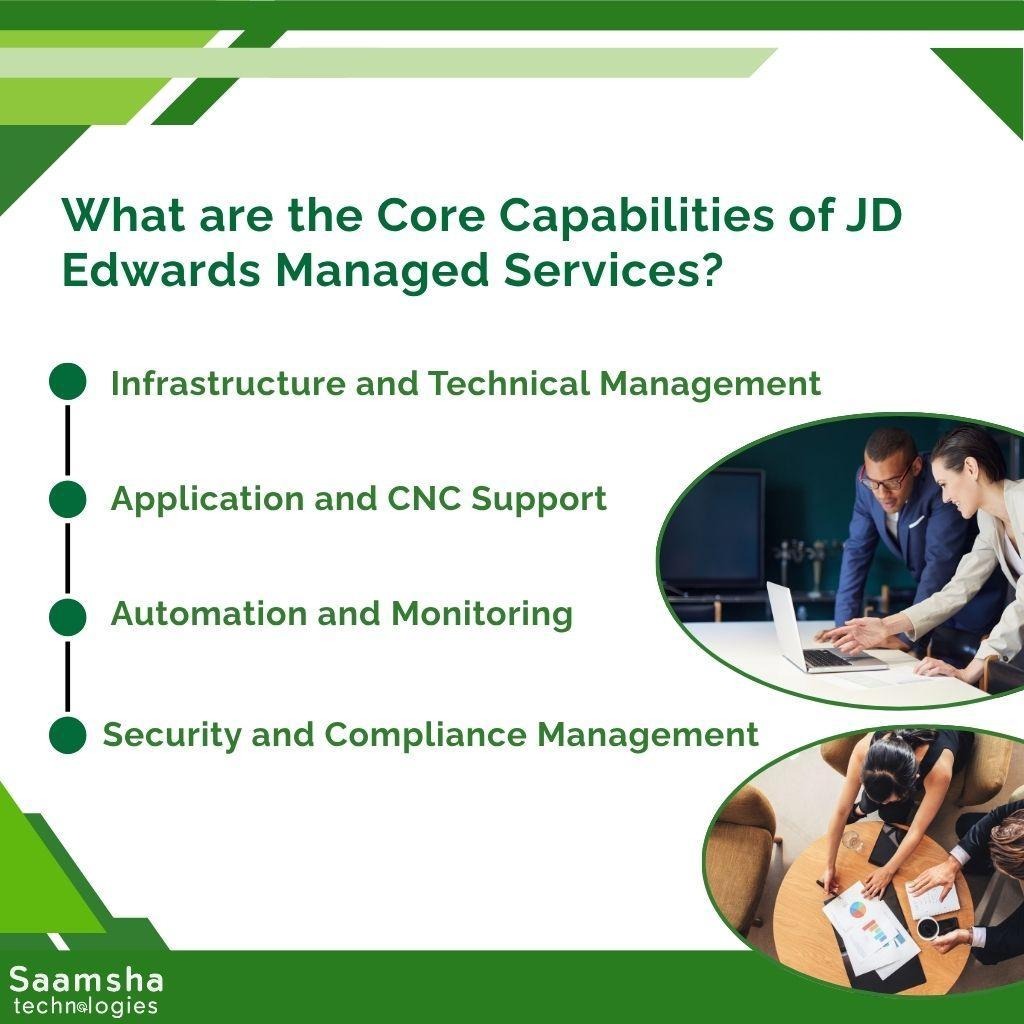
What are the Core Capabilities of JD Edwards Managed Services?
Supporting JD Edwards environments needs strong technical control, steady monitoring, and expert handling of core ERP functions.
Managed services help organizations run systems smoothly, reduce downtime, keep performance stable across infrastructure, applications, and security layers.
Infrastructure and Technical Management
Infrastructure, technical management keep the JD Edwards system stable and reliable. It includes server management, operating system support, and handling of cloud or on-premises setups.
They also plan for high-availability disaster recovery to avoid data loss and system failures. This ensures the system stays available during peak use and unexpected issues.
Application and CNC Support
Application and CNC support focus on JD Edwards EnterpriseOne system control. It includes CNC administration, application setup, and issue resolution. Teams handle system configuration and performance improvements. It also support for developing and maintaining customized JDE EnterpriseOne technical objects like Business Functions (C/NER), BI Publisher reports, RDAs, UBEs etc
They also manage ESU update system patches from Oracle. This keeps the application up to date and reduces system errors.
Automation and Monitoring
Automation and monitoring keep the system under constant control. Monitoring tools check system health and detect problems early. Alerts notify teams when failures or performance drops occur.
This allows quick action before issues grow. Workflow automation supports finance and operations tasks and reduces manual effort.
Security and Compliance Management
Security and compliance management protect system data and access. Role-based security controls user access at different levels. Segregation of duties helps prevent fraud and control risks.
Regular patch updates fix security gaps and protect the system. Compliance checks support audit needs, keep the system aligned with business rules and regulations.
When Should Businesses Consider Managed Services?
Businesses usually move to JD Edwards managed services when internal teams cannot maintain system stability and performance.
Rising complexity, skill gaps, and business expansion make in-house support difficult to sustain.
- Operational triggers include frequent system downtime or slow performance that affects daily operations and reporting accuracy.
- The lack of skilled JD Edwards professionals within the internal team creates support gaps and delays in issue resolution.
- Difficulty managing upgrades, patches, and third-party integrations increases system risk and maintenance workload.
- Business growth, such as expansion into new regions or new business units, increases ERP load and complexity.
- ERP modernization, cloud migration needs, and rising compliance or reporting demands require stronger system control and expert support.
Final Words
JD Edwards managed services enable organizations to reduce their operational burden, improve system reliability, and gain access to specialized ERP expertise. By outsourcing critical support functions, businesses can ensure their systems remain optimized, secure, scalable, and aligned with changing business requirements.
Managed services can also help organizations identify system issues early, improve performance, manage updates, and reduce unexpected downtime. This allows internal IT teams to focus more on strategic projects and business growth rather than routine ERP maintenance.
With experienced partners like Saamsha Technologies, enterprises can modernize their JD Edwards environment, improve system efficiency, and adopt new technologies while focusing on strategic growth. Ultimately, managed services can transform JD Edwards EnterpriseOne from a maintenance-heavy system into a business-enabling platform that drives efficiency, agility, productivity, and long-term business value.