
JD Edwards Security Best Practices for Enterprise ERP Environments
Enterprise Resource Planning systems manage an organization’s most valuable business information, making security a critical priority. Whether deployed on-premises, in the cloud, or in hybrid environments, JDE is widely used by enterprises to manage finance, supply chain, manufacturing, procurement, and human resources.
As organizations expand their digital operations and integrate cloud services, the security of JD Edwards ERP becomes increasingly important.
Poor access controls, outdated security configurations, or excessive user permissions can expose sensitive business data, disrupt operations, and create compliance risks.
By following proven security best practices, organizations can protect their ERP environment, reduce cyber risks, and maintain business continuity.
Why Is Security Essential for JD Edwards ERP?
JD Edwards software supports business-critical operations where a security incident can have significant financial and operational consequences.
- Unauthorized access to financial records, customer information, payroll data, or supplier details can result in fraud, regulatory penalties, and reputational damage.
- Cyber threats are no longer limited to external attackers. Insider threats, accidental data modifications, and excessive user privileges also present major risks.
- A strong security strategy helps organizations protect data integrity while ensuring users can only perform the tasks required for their roles.
Need expert JD Edwards support? Partner with Saamsha Technologies to modernize your ERP, improve security, and maximize operational efficiency with tailored solutions.
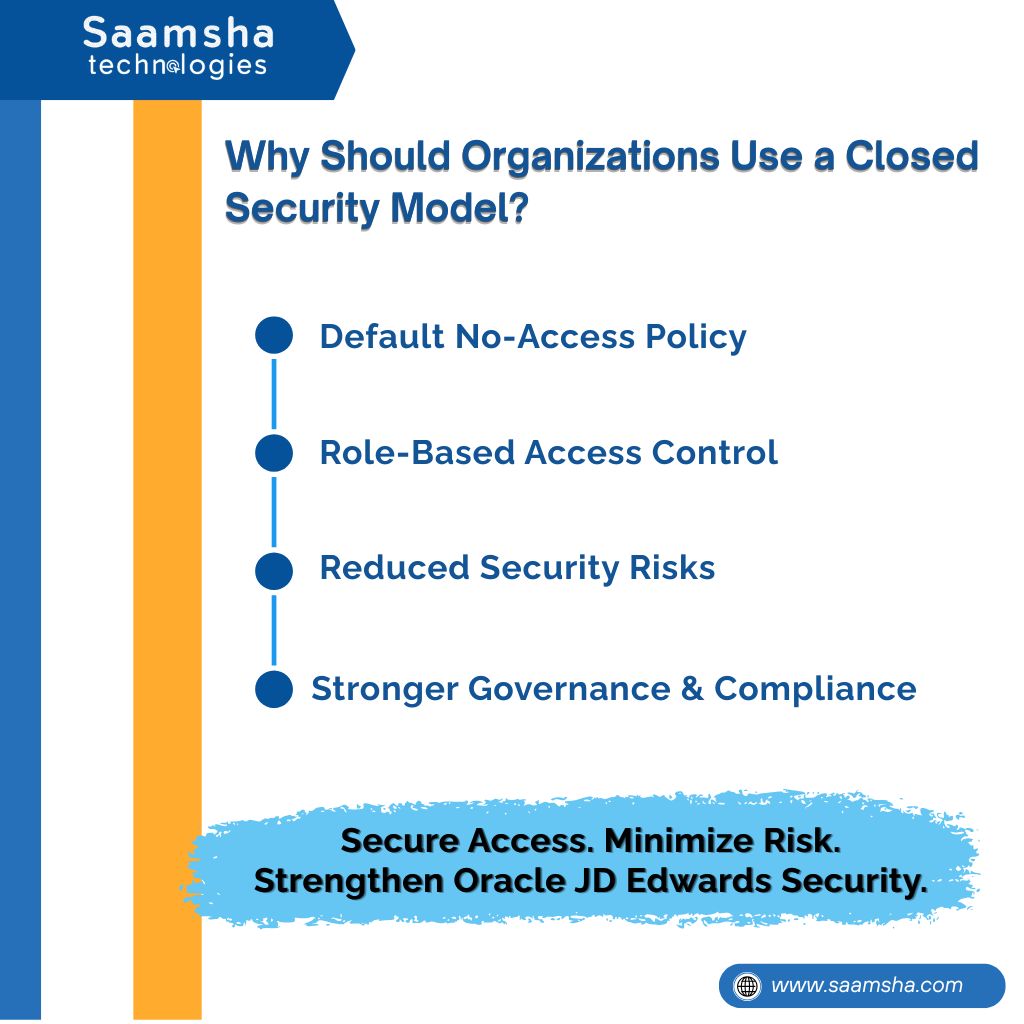
Why Should Organizations Use a Closed Security Model?
One of the most effective security practices is implementing a closed security model. Many organizations originally configured older Oracle JD Edwards environments with an open security model that automatically granted users broad system access.
- A closed security model follows the principle of least privilege. New users receive no access until appropriate permissions are assigned.
- Every application, function, and business process must be explicitly granted through defined security roles.
- This approach minimizes unauthorized access, reduces opportunities for fraud, and strengthens overall governance across the ERP environment.
- Whether deployed on-premises, in the cloud, or in hybrid environments, JDE is widely used by enterprises to manage finance, supply chain, manufacturing, procurement, and human resources.
How Does Role-Based Access Control Improve JDE Security?
Role-Based Access Control (RBAC) is the foundation of modern JDE security. Instead of assigning permissions individually to every employee, organizations create roles based on business responsibilities such as Accounts Payable, Purchasing, Inventory Management, Finance, or Human Resources.
- When employees change positions, administrators simply update their assigned roles instead of modifying dozens of individual permissions.
- RBAC also supports compliance requirements by ensuring users only access the applications and functions necessary for their daily responsibilities.
- Many organizations also benefit from process-based roles rather than broad job-based roles.
- Splitting processes like voucher entry, voucher approval, and payment authorization into separate roles strengthens security while making user management more efficient.
- Clearly defined roles also simplify onboarding, offboarding, and periodic access reviews, helping organizations maintain a secure and well-governed ERP environment.
Secure and optimize your JD Edwards environment with Saamsha Technologies. Connect with our experts for implementation, upgrades, managed support, and security consulting.
How Can Businesses Secure Applications and Business Data?
Application security controls which programs users can access, while action security determines whether users can add, modify, delete, or approve records.
Processing option security restricts changes to reports and batch jobs that affect business operations. Data protection should extend to database tables through table security and row-level security.
These controls ensure that users access only information relevant to their department, location, or business unit. Organizations should also implement field-level security where appropriate to protect highly sensitive information further.
You should protect sensitive financial and customer information by using encryption and data masking wherever appropriate.
Why Is Segregation of Duties Important?
Segregation of Duties (SoD) is one of the most important principles of ERP security. No single employee should control an entire high-risk business process.
For example: The same user should not be able to create vendors, modify banking details, approve invoices, and release payments.
Dividing these responsibilities among different users significantly reduces the possibility of fraud and creates a clear audit trail. Organizations should regularly review user roles to identify conflicting permissions that violate SoD policies.
Periodic access reviews help maintain compliance and strengthen internal controls as business processes evolve.
How Should Production Environments Be Protected?
Development, testing, and production environments require different levels of security.
- Production systems contain live business data and therefore demand the highest level of protection.
- Access to production should be limited to authorized personnel only. Developers and technical administrators should perform most activities in development or testing environments before approved changes are deployed to production.
- Temporary administrative access should be granted only when necessary, and every privileged activity should be logged for auditing purposes.
- Protecting production environments from unauthorized changes helps maintain system stability while reducing operational and security risks.
Accelerate your Oracle JD Edwards journey with Saamsha Technologies. Talk to our experts for reliable implementation, optimization, support, and long-term ERP success.
How Can Organizations Strengthen Their Overall Security Strategy?
Securing Oracle JD Edwards requires multiple layers of protection working together. These are some ways your organisation can follow:
- Strong password policies, multi-factor authentication, encryption, network security, regular software updates, vulnerability assessments, and disaster recovery planning all contribute to a resilient ERP environment.
- Organizations should also stay current with Oracle’s continuous updates to receive important security patches and performance improvements.
- Employee security awareness training is equally important, as human error remains one of the leading causes of security incidents.
- Regular reviews, policy updates, and continuous monitoring help organizations adapt to evolving cyber threats while protecting critical business operations.