Integrating JD Edwards ERP with external systems has become essential for businesses looking to eliminate data silos, reduce manual processes, and improve operational efficiency.
Many organizations still struggle with disconnected ERP, WMS, CRM, and cloud applications, resulting in delays, duplicate data entry, and limited real-time visibility across operations.
By leveraging JD Edwards Orchestrator, APIs, and Oracle Cloud Infrastructure (OCI) services, companies can build scalable and secure integrations that streamline workflows and enable faster decision-making.
This blog will explain how JD Edwards Orchestrator simplifies enterprise integration, how APIs connect JDE with external systems, and how Oracle Integration Cloud (OIC) and OCI services enable scalable automation and AI-driven workflows.
What Is JD Edwards Integration and Why Does It Matter for Modern Businesses?
JD Edwards integration is the process of connecting Oracle’s JD Edwards ERP Operations with external applications, databases, cloud platforms, and IoT devices to enable seamless data exchange across business operations.
Modern organizations rely on JD Edwards to manage finance, manufacturing, inventory, and supply chain processes. Still, integration is essential for connecting these core systems with CRMs, e-commerce platforms, WMS solutions, and analytics tools.
Real-time integration helps businesses eliminate data silos, reduce manual data entry, and improve operational accuracy.
With tools such as JD Edwards Orchestrator, REST APIs, Oracle Integration Cloud (OIC), and OCI services, companies can automate workflows, synchronize data instantly, and enable intelligent decision-making across connected systems and dashboards.
These integrations also improve customer and vendor experiences by providing better visibility into orders, inventory, and financial processes while enabling scalable, future-ready ERP automation.
How Does JDE Orchestrator Simplify Enterprise Integration?
JD Edwards Orchestrator is a built-in EnterpriseOne tool that enables businesses to automate workflows and integrate JD Edwards with external applications, cloud services, mobile apps, and IoT devices through REST-based services. This is how it simplifies enterprise integration:
- Supports low-code and no-code automation, reducing the need for complex custom development.
- Uses Orchestrator Studio’s intuitive graphical interface to create and manage workflows easily.
- Enables secure REST API communication through the AIS Server for seamless third-party integrations.
- Automates event-driven workflows based on real-time business activities and system conditions.
- Allows scheduled orchestrations and automated notifications for issues such as low inventory or delayed shipments.
- Provides real-time data synchronization between JD Edwards and external systems.
- Integrates with IoT devices, cloud services, mobile applications, and enterprise platforms.
- Offers centralized orchestration management for improved monitoring, control, and operational visibility.
- Eliminates repetitive manual tasks, improving efficiency and reducing human errors.
- Helps modernize legacy ERP operations without requiring major infrastructure changes.
How Can APIs Connect JDE with External Systems?
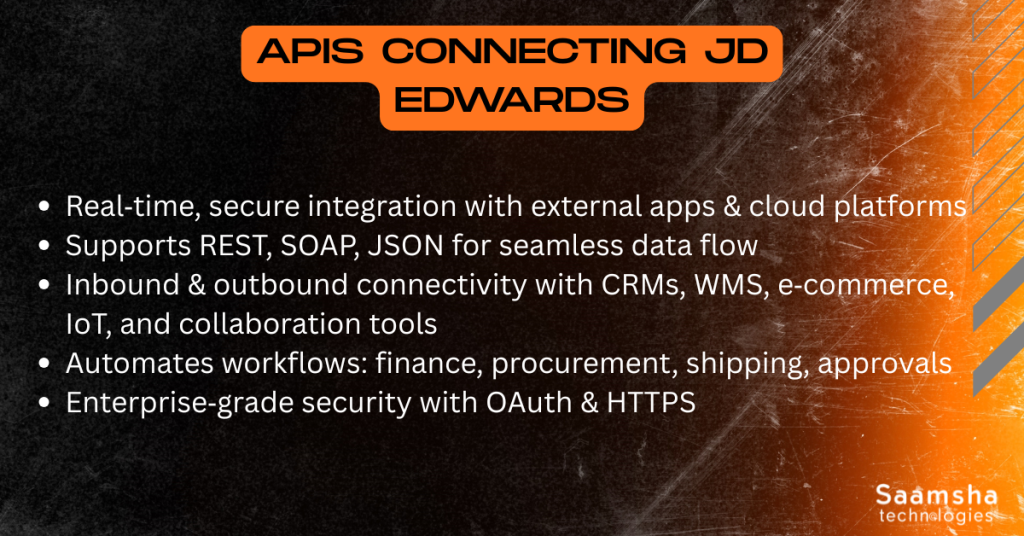
APIs help JD Edwards EnterpriseOne connect with external applications, cloud services, and enterprise platforms through secure, real-time communication. This enables businesses to automate workflows, synchronize data, and improve operational efficiency.
- Supports REST APIs, SOAP web services, and lightweight JSON communication for seamless system integration.
- Enables both inbound and outbound API interactions between JD Edwards and third-party platforms.
- Integrates with CRM platforms like Salesforce for customer and sales data synchronization.
- Connects warehouse management systems (WMS) for inventory tracking and shipping coordination.
- Supports e-commerce applications for automated order processing and real-time inventory updates.
- Integrates Microsoft Teams and Outlook for approvals, alerts, and collaboration workflows.
- Connects IoT devices and SCADA systems for predictive maintenance and equipment monitoring.
- Uses OAuth authentication and HTTPS security for secure enterprise-grade connectivity.
- Automates financial workflows, procurement processes, and shipping notifications through JD Edwards Orchestrator and Open API connectors.
What Role Do Oracle Cloud Infrastructure Services Play in JD Edwards ERP?
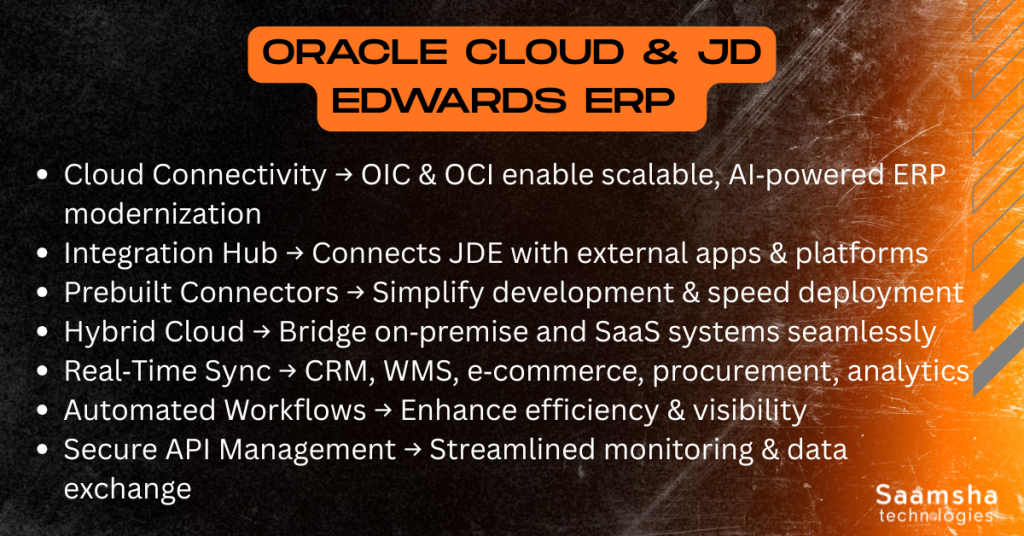
Oracle Integration Cloud (OIC) and Oracle Cloud Infrastructure (OCI) help businesses modernize JD Edwards ERP with cloud connectivity, automation, AI services, and scalable infrastructure.
Together, they improve integration, operational efficiency, and intelligent decision-making.
- Acts as a centralized integration hub connecting JD Edwards with external applications and cloud platforms.
- Uses prebuilt adapters, templates, and JD Edwards connectors to reduce custom development efforts.
- Supports hybrid cloud integration between on-premise systems and SaaS applications.
- Enables real-time data synchronization across CRM, WMS, e-commerce, procurement, and analytics platforms.
- Automates cross-functional workflows and improves enterprise-wide operational visibility.
- Simplifies API management, monitoring, and secure data exchange between systems.
How Do OCI Services Bring AI and Automation to JD Edwards Software?
OCI provides scalable cloud infrastructure, automated provisioning, and high-performance hosting capabilities that help businesses run JD Edwards more efficiently.
Features such as load balancing, autonomous databases, backup management, and system monitoring improve reliability, availability, and overall ERP performance while reducing manual maintenance efforts.
OCI also brings AI and automation capabilities to JD Edwards through services like AI-powered document understanding, which can automatically extract data from invoices, receipts, and forms.
Machine learning and predictive analytics help organizations improve demand forecasting, maintenance planning, and operational decision-making.
By supporting intelligent ERP workflows, automated reporting, and cloud modernization initiatives, OCI enables businesses to strengthen continuity, enhance scalability, and build a future-ready JD Edwards environment.
How Saamsha Technologies Can Integrate JD Edwards with External Systems?
Saamsha Technologies can integrate JD Edwards EnterpriseOne and World with external applications, cloud platforms, and enterprise systems to improve operational efficiency and automate processes.
With expertise in JD Edwards implementation, customization, APIs, Orchestrator, and integration services, we enable seamless connectivity between JDE and CRM platforms, WMS solutions, e-commerce applications, analytics tools, and IoT systems.
Our expert consultants support end-to-end integration, data migration, workflow automation, and real-time synchronization across business processes.
We also help organizations modernize legacy JDE environments, improve analytics, reduce operational costs, and enhance productivity through scalable, secure, and future-ready ERP integration solutions tailored to business requirements.
Final Takeaway
IIntegrating JD Edwards with external systems through Orchestrator, APIs, OIC, and OCI services enables businesses to streamline workflows, improve data exchange, and gain better real-time visibility across their operations. These technologies also support ERP modernization by creating secure, reliable connections between JD Edwards and other business applications.
From cloud integration and AI-powered automation to secure data synchronization, these solutions help organizations develop scalable and future-ready enterprise environments. They can improve operational efficiency, reduce manual work and costs, strengthen connectivity, and support long-term digital transformation initiatives.