
Production scheduling is one of the most challenging processes for manufacturing companies. In your organization, even a small scheduling error can create production delays, material shortages, excess inventory, or inefficient use of machines and labour.
To determine the correct schedule, you need reliable information on raw material availability, production capacity, demand, and existing orders.
Infor LX (BPCS) helps you integrate this information within an integrated ERP environment. By connecting inventory, procurement, shop-floor operations, order data, and production planning, it enables you to develop production schedules based on a more complete view of Infor LX (BPCS) for Lean Manufacturing improve requirements.
This blog will help you understand what production scheduling is, the benefits of accurate scheduling with Infor ERP LX BPCS, why scheduling goes wrong, and more.
What Is Production Scheduling in the Manufacturing Industry?
In the manufacturing industry, production scheduling is the process of deciding what to produce, when to produce it, and which resources or materials you should utilize.
It translates the overall production plan and customer demand into detailed, day-to-day production activities for your organization.
A production schedule tells you the products and quantities required, start and end dates, number of machinery or work centers, workforce, raw materials, and other resources.
If you can effectively utilize these resources within defined tasks and timeframes, then you can easily maintain production continuity and product delivery targets.
Also, this helps your managers to identify potential problems like equipment downtime, raw material shortages, capacity constraints, production bottlenecks, etc., which can help you avoid significant delays.
Additionally, this helps you align production capacity and product availability with customer demand and also build better coordination between sales and production departments.
An effective scheduling process also depends on the quality of the planning maintaining master data in Infor LX used to create the schedule. Information such as demand, bills of material (BOMs), inventory, production lead times, routings, work-centre capacity, and production calendars can influence production dates and resource requirements.
How Does Infor LX (BPCS) Help Your Organization to Improve Production Scheduling?
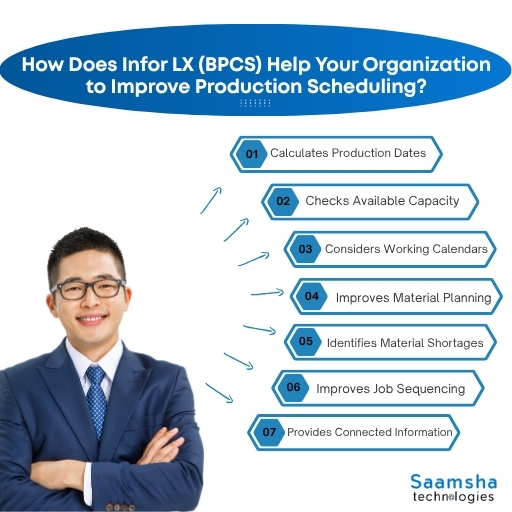
Infor LX (BPCS) can help your organization to improve your production scheduling by connecting demand, materials, capacity, and manufacturing activities within a single system. Here is how it helps:
- Calculates Production Dates: Infor LX generally uses backward scheduling to calculate when you should start production as per the customer due date. This considers factors like run, queue, and move time.
- Checks Available Capacity: You can consider available machine hours, work centres, shifts, and other capacity limits before you schedule production. This helps you avoid assigning more work than your resources can handle.
- Considers Working Calendars: The system can also calculate the non-working days, holidays, and available shift capacity. For that, your planned production dates become more realistic.
- Improves Material Planning: Infor LX connects production requirements with MPS, MRP, inventory, and BOM data. You can now easily identify the raw materials and components required before starting production.
- Identifies Material Shortages: By checking available inventory and material requirements, you can identify potential shortages earlier and avoid scheduling jobs that you may not complete on time.
- Improves Job Sequencing: You can organise production orders based on priorities and available resources. This can help you reduce unnecessary delays and changeovers.
- Provides Connected Information: Though your production, inventory, purchasing, and planning data are available within the ERP environment, you can reduce reliance on separate spreadsheets.
Improve your production planning and scheduling with expert Infor LX (BPCS) implementation, customization, upgrades, and ongoing support from Saamsha Technologies. Connect with our Infor LX experts today.
What Is the Reason Behind Production Scheduling Inaccuracy?
Production scheduling becomes inaccurate when the information used to build the schedule does not match actual shop-floor conditions. Some of the most common reasons include:
- Inaccurate Data: If your inventory records, BOMs, cycle times, or supplier lead times are outdated, then this can create production schedules that will be difficult to follow.
- Manual Scheduling: When you use Excel, whiteboards, or manual data entry, that can increase the chances of errors and make it harder to update schedules easily.
- Unrealistic Capacity Planning: Your schedule may consider total machine hours without accounting for breaks, maintenance, cleaning, inspections, or setup time.
- Unexpected Machine Downtime: If there are sudden equipment breakdowns or maintenance, that can impact available capacity and delay other scheduled jobs.
- Incorrect Cycle Times: If a job takes longer than expected, it can delay the next jobs and affect your entire production sequence.
- Labour and Skill Gaps: Your organization may have enough workers but not the right skilled employees for the available production tasks.
- Disconnected Systems: If your sales, inventory, purchasing, and production systems are not connected, you may work with different or outdated information.
What Are the Advantages of Using Infor LX for Production Scheduling?
Do you know what the advantages of using Infor LX (BPCS) for production scheduling. Infor LX BPCS ERP consulting can help you create more practical schedules for your organization that can improve the use of materials, machines, and other resources. These are the key benefits:
- Better Resource Utilization: You can plan production according to available machines, work centres, labour, and materials. This can help you reduce both resource overload and unnecessary idle time.
- Improved Delivery Performance: More accurate production dates help you complete orders according to customer requirements and reduce the risk of missed deadlines.
- Reduced Material Waste: Infor LX supports yield factors, by-products, and co-products. This also helps you manage materials more accurately and reduce unnecessary waste.
- Better Production Control: With features like lot tracking, serial number management, and engineering change control, this can give you better visibility for your manufacturing activities.
- Less Manual Work: You can reduce your dependence on spreadsheets and repetitive manual processes by automated planning, monitoring, alerts, and reporting.
- Improved Decision-Making: Connected production, inventory, and planning information can help your team to identify shortages or capacity issues earlier and make faster decisions.
- Flexible Deployment: Your organization can use Infor LX in an IBM i environment or adopt cloud-based options according to your operational requirements.
Final Thoughts
Manufacturers need connected data, faster planning, and better visibility to respond to changing demand, material shortages, and capacity constraints.
Infor LX (BPCS) can support this transition by connecting production planning with inventory, procurement, capacity, and shop-floor information.
Using Infor ERP LX BPCS, you can reduce your dependence on manual scheduling and make faster, data-driven decisions.
With accurate operational data and the right planning practices, ERP LX software can help your organization build more reliable, responsive, and efficient production schedules.
Get more value from your Infor ERP LX BPCS environment with reliable implementation, integration, administration, and production support. Partner with Saamsha Technologies today.