
Replacing IBM i refers to changing the entire system from IBM i (AS/400) to a new technology or replacing the applications.
On the other hand, modernization means improving your outdated existing system according to your business needs with modern technology and upgrades.
Before you decide to replace your entire IBM i system, you must understand all aspects, such as hidden costs, when you should consider replacing it, and how you can modernize your system without a full replacement.
What are the Hidden Costs of Replacing the IBM i System?
You may need extensive user training, application redevelopment, data migration, integration changes, and major changes to your established business processes.
You have to also risk losing decades of specialised business logic built into your existing system.
Before committing to a full replacement, consider these often-overlooked costs and whether modernization can help you achieve your goals through a more gradual, lower-risk approach.
1. Rewriting Decades of Business Logic
Your IBM i (AS/400) applications may contain business rules built into RPG code over many years. Replacing the system means your team may need to understand, rebuild, and test these rules again. Some important rules may also be hard to find if they were never documented.
- Modernize Instead: You can update existing RPG applications instead of replacing them. Convert older RPG code to Free Format RPG, divide programs into smaller parts, and add SQL where needed.
2. Employee Retraining and Productivity Loss
Your employees already know your IBM i system and its processes. A new system requires them to learn new screens and workflows. This can take time and may reduce productivity during the transition.
- Modernize Instead: Improve your existing user interfaces with modern, web-based screens. This can make applications easier to use without requiring your employees to learn a completely new system.
3. Rebuilding Critical Integrations
Your AS/400 operating system may connect with EDI, warehouse, shipping, finance, and other systems. Replacing IBM i may require you to rebuild and test these connections.
- Modernize Instead: You can connect existing IBM i applications with newer systems through modern APIs. This lets you add new tools while keeping your existing business logic.
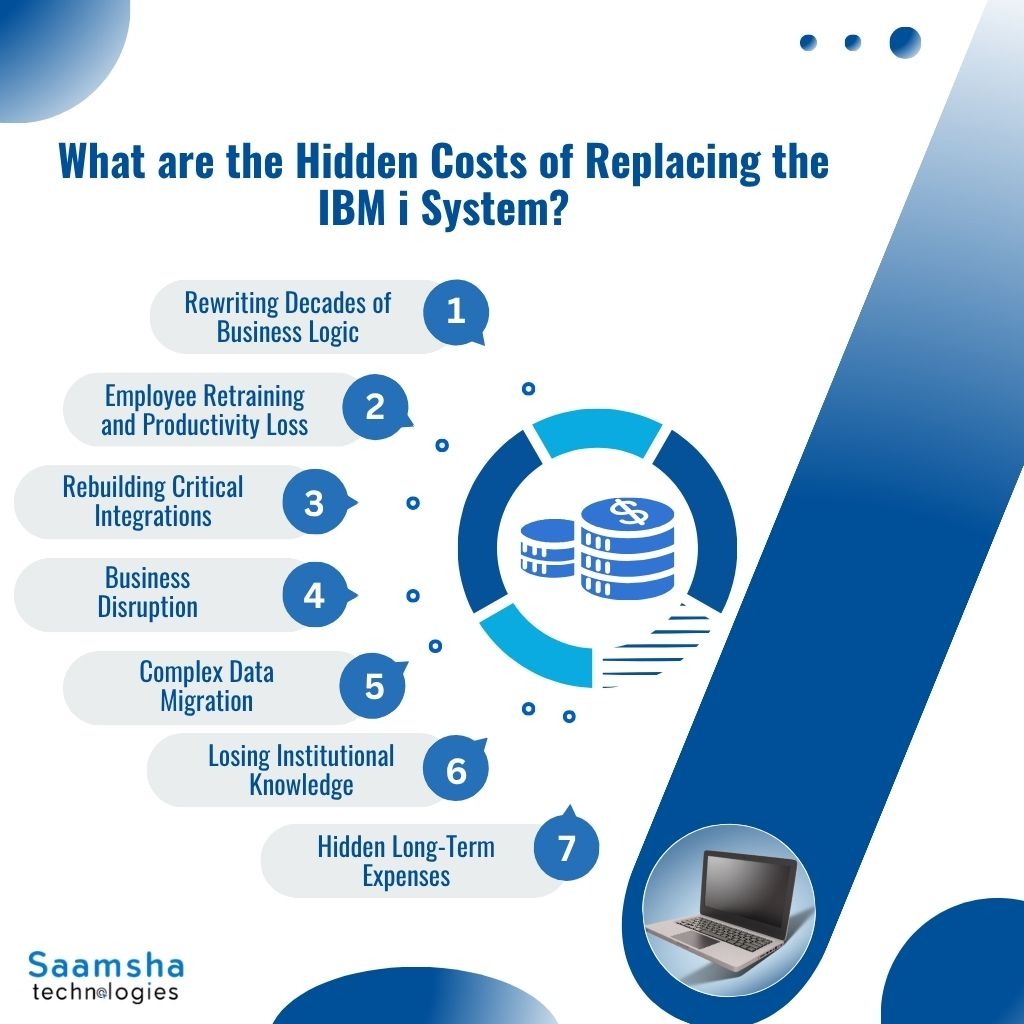
4. Business Disruption
Testing, data migration, integration changes, and system cutover can affect your daily operations. Unexpected problems may also cause delays, downtime, and extra pressure on your IT team.
- Modernize Instead: Modernize your system step by step. You can start with selected screens, applications, or data processes while keeping your core operations running.
5. Complex Data Migration
Moving years of business data is not always simple. Your team may need to clean, organize, check, and move the data while protecting historical records and audit information.
- Modernize Instead: Improve your database gradually through better SQL access, updated data structures, and stronger security. You do not have to move everything to a new platform at once.
6. Losing Institutional Knowledge
Your AS/400 operating system may contain years of business knowledge in RPG code, custom applications, and employee workflows. Some of this knowledge may not be documented.
- Modernize Instead: Review your technical setup and business processes first. Document how your applications work and where important business rules are stored.
7. Hidden Long-Term Expenses
Replacing your IBM i system can involve more than software costs. Licenses, consulting, customization, integration, training, support, and delays can increase your total investment.
- Modernize Instead: Focus on the areas that need improvement first. By reducing technical debt step by step, you can improve your IBM i environment without replacing functions that already work well.
Transform your legacy IBM i (AS/400) systems into scalable, secure, and future-ready applications with our expert modernization services. Contact Saamsha Technologies today!
Difference Between IBM i Modernization vs Full Replacement
Modernization means keeping the existing system and changing it as per your business needs. Full replacement refers to replacing the entire application. Read the table below to learn more:
| Factor | IBM i Modernization | Full Replacement |
| Approach | This upgrades existing IBM i applications but retains the core system. | This process moves operations to a new ERP, SaaS, or custom platform. |
| Business Logic | It preserves proven RPG logic and customized workflows. | You need to remap or rebuild the workflows and existing logic. |
| Timeline | This delivers improvements incrementally without waiting for complete transformation. | It usually requires a longer implementation before you achieve full value. |
| Integrations | You can retain the existing integrations and enhance with APIs. | Integrations may require complete rebuilding and retesting. |
| Technical Debt | This reduces legacy debt through targeted refactoring. | It removes legacy architecture but may introduce new complexity. |
With Saamsha Technologies, you can upgrade legacy applications, modernize interfaces, enable APIs, and improve performance without disrupting your critical business operations. Contact us now.
Final Thoughts
Replacing your IBM i may give you a fresh start, but the hidden costs of rebuilding business logic, migrating data, and restoring integrations can erase the expected benefits.
Instead, AS/400 modernization is a more practical path for organisations. By gradually improving applications, APIs, interfaces, security, and development practices, you can protect years of valuable investment.
Also, with modern technologies such as cloud, AI, automation, and real-time analytics, you can reshape enterprise technology. A modernized IBM i (AS/400) environment can provide a strong foundation for future growth without forcing you to start from zero.
Ready to modernize your IBM i environment without the cost and disruption of a full replacement? Partner with Saamsha Technologies to transform legacy applications, APIs, and interfaces for future-ready growth.

