JD Edwards ERP software World helped many businesses to manage their daily operations for many years. But changing business needs and older technology made it difficult to keep the system up to date.
As Oracle transitioned JD Edwards World to Sustaining Support after April 30, 2025, organizations are increasingly considering migration to newer platforms.
Moving to JD Edwards EnterpriseOne 9.2 offers enhanced reporting, increased automation, better mobile access, and cloud-ready capabilities.
But the process can be difficult because of legacy customizations, system integrations, and data transfer. In this blog, we will discuss all the important steps before migration.
Why You Need to Assess JD Edwards Software Customizations Before Migration
Before your organization moves to EnterpriseOne, you have to understand how your existing JD Edwards World customizations support daily business operations.
Over time, your system may have stored different custom programs, reports, modified business logic, and third-party integrations. Some of them may still be useful, and some may be outdated or unused.
If you carry every customization into EnterpriseOne, that may increase development costs, create compatibility issues, and extend migration timelines.
A detailed assessment can help you to identify which customizations you can retain, redesign, replace with standard EnterpriseOne functionality, or retire.
This also helps you uncover Integrating JD Edwards with External Systems integration dependencies, understand technical limitations, and prioritize critical business processes.
From this, your team can get a clear migration scope, and your organization can reduce unnecessary development and testing efforts.
At Saamsha Technologies, we provide expert JD Edwards migration support to help you assess customizations, reduce technical risks, and prepare your business for EnterpriseOne. Connect with us to plan a smoother migration.
How Can You Build a Complete Inventory of Existing Customizations?
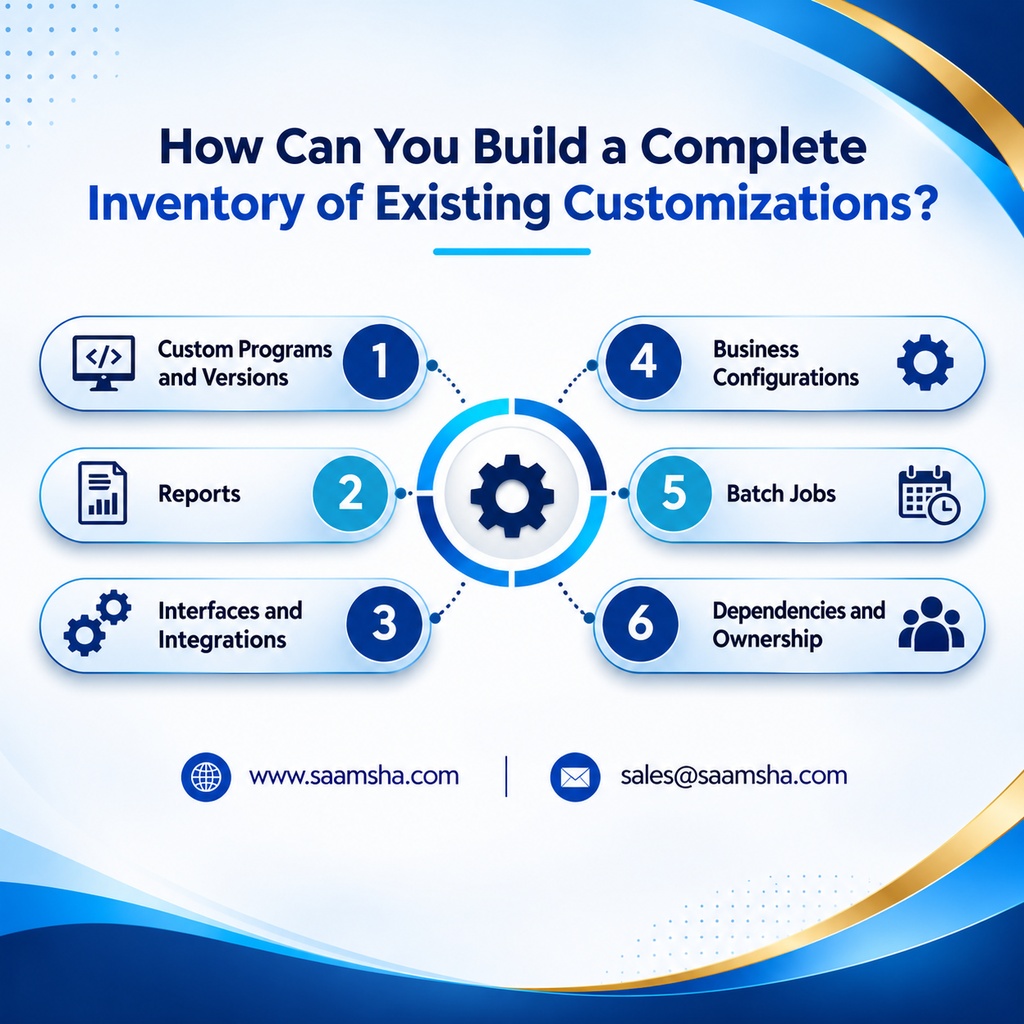
You can start by reviewing your existing JD Edwards World environment and documenting every customization that may affect migration. You may focus on these areas:
- Custom Programs and Versions : Your team needs to identify modified programs, custom business logic, unused objects, and redundant versions that require review.
- Reports : List reports created using World Writer, FASTR, and STAR Report. Identify reports that need rebuilding, replacement, or retirement.
- Interfaces and Integrations : You can document EDI transactions, external applications, data feeds, and file-based connections that depend on World.
- Business Configurations : Your team needs to review AAIs, UDCs, category codes, processing options, menus, and security settings for obsolete or unused configurations.
- Batch Jobs : You need to identify scheduled jobs, background processes, and automated workflows that support daily operations.
- Dependencies and Ownership : You should record each customization’s business purpose, usage frequency, dependencies, responsible team, and business importance.
How To Evaluate the Business Value of Each Customization DJ Edwards Migration?
The team should review each customization to understand whether it still serves a genuine business need. You can consider these four factors before deciding what to carry into EnterpriseOne:
- Your Business Requirements : Will the customization support essential operations, industry-specific processes, or regulatory requirements? Try to identify the functions your teams cannot operate without.
- Its Current Usage : Check whether employees actively use the customization or whether it supports an outdated process that you can discontinue.
- Available EnterpriseOne Features : You can compare existing custom functionality with standard EnterpriseOne capabilities. Features like personalization and Orchestrator may help you achieve similar results without additional custom development.
- Your Maintenance Costs : Your team needs to evaluate the development effort, support requirements, technical dependencies, and future upgrade impact of retaining each customization.
How Can You Find Customization Compatibility with EnterpriseOne?
You can use Oracle JD Edwards Change Management utility tools to examine custom objects, identify modifications, and estimate the effort required to maintain them in JD Edwards EnterpriseOne Support Services.
- Customization Object Analyzer (COA): You may use the R9840DL process to find customized objects and their parent-child dependencies. The summary and detailed reports help you understand the extent of your customizations.
- Decustomizer Analysis Report : Your internal team can run R9540DC and R9540DCR to identify traditional user interface modifications that you may replace with EnterpriseOne personalization and User Defined Objects (UDOs).
- Customization Workbench : You can use P96UCUST or P98UCUST to review the customized objects, examine modification flags, and compare custom code with Oracle’s standard logic.
- Software Update Impact Analysis : Use Change Assistant to identify custom objects affected by incoming Electronic Software Updates (ESUs).
How to Prioritize Your Customization Remediation Before Migration?
Organizations need to prioritize their JD Edwards World customizations based on two factors, which are business value and technical complexity.
This helps you to decide which modifications you can keep, redesign, replace, or retire before moving to EnterpriseOne.
- High Business Value, Low Complexity: Retain essential customizations that require minimal redevelopment and prioritize them for migration.
- High Business Value, High Complexity : Try to retain essential customizations that require minimal redevelopment and prioritize them for migration.
- Low Business Value, Low Complexity : Replace these customizations with standard EnterpriseOne functionality wherever possible.
- Low Business Value, High Complexity : You can retire these modifications to avoid unnecessary development and maintenance costs.
What Testing Is Essential After Customization Remediation?
After remediating your JD Edwards World customizations, you need to test each component to confirm it works correctly in EnterpriseOne and supports your business processes.
- Unit Testing : You can check individual custom programs, reports, batch applications (UBEs), and business functions.
- Data Validation : Always try to verify custom tables, indexes, field mappings, and converted data to identify truncation or schema errors.
- Integration Testing : Also, you need to test EDI transactions, third-party applications, file exchanges, and automated jobs connected to EnterpriseOne.
- End-to-End Testing : Run complete business workflows, such as order-to-cash and procure-to-pay, to check how customized and standard processes work together.
- User Acceptance Testing (UAT) : You may ask your business teams to test real operational scenarios and validate requirements.
- Performance and Cutover Testing : Try to check batch processing under heavy workloads and conduct mock migration runs to identify errors and estimate downtime.
How Saamsha Technologies Can Support Your JD Edwards Migration
At Saamsha Technologies, we can help you to manage your JD Edwards environment with experienced technical consultants.
Whether you use JD Edwards World or EnterpriseOne, our team can help your migration planning, application development, customization, ongoing maintenance requirements, etc.
- Migration and Upgrades : Support upgrade planning, impact analysis, and data migration.
- Development and Customization : Assist with custom programs, reports, interfaces, and application enhancements.
- Technical and Functional Support : Help you address application issues, simplify business processes, and improve system performance.
- Managed Services : Provide on-site and offshore resources for maintenance, production support, and helpdesk operations.
With experience across industries such as manufacturing, healthcare, energy, and financial services, Saamsha Technologies delivers reliable JD Edwards and AS/400 expertise across India and the USA. Contact us now!
Final Thoughts
Migrating to EnterpriseOne is just a step towards a more flexible and future-ready business for your organization. By assessing your existing customizations, you can reduce technical challenges, control costs, and make better use of modern ERP features.
Contact Saamsha Technologies, and with proper planning and expert support, you can build an ERP environment that adapts to changing business requirements and supports long-term growth.