
JD Edwards EnterpriseOne(E1) users are entering a crucial phase in 2026. While Oracle’s long-term support provides stability, growing business needs such as AI-driven automation, cloud integration, and compliance requirements are prompting companies to rethink their existing systems.
ERP systems connect business functions, enabling data to flow smoothly across departments, reducing manual work and improving accuracy. This idea dates back decades, when JD Edwards combined multiple business processes into a single system.
Today, that same foundation remains relevant, but expectations have evolved. With Release 26 introducing modern capabilities, businesses now have the opportunity to strategically upgrade their JD Edwards without completely replacing their existing environment.
Let’s understand the complete landscape of JD Edwards E1 in 2026, including an overview of the platform, followed by key Release 26 updates, emerging trends, major challenges, and more.
What Is JD Edwards and Who Still Uses It?
JD Edwards is the longest-supported ERP platform in the IBM i ecosystem. It is known for its reliability, performance, and deep customisation capabilities.
Widely used in manufacturing, distribution, and finance, it manages critical processes such as procurement, inventory, order management, and financial reporting within a single integrated system.
Despite being a legacy platform, JD Edwards continues to deliver stable, high-volume transaction processing with minimal downtime.
With long-term support and modernisation pathways, it remains a cost-effective choice for organisations prioritising consistency and control.
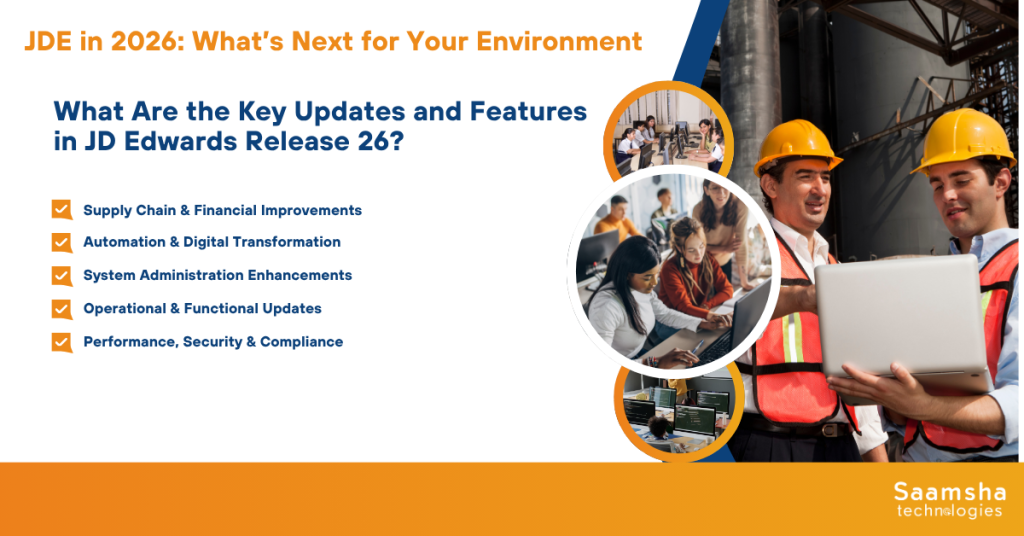
What Are the Key Updates and Features in JD Edwards Release 26?
JD Edwards Release 26 focuses on practical enhancements that improve efficiency, automation, and usability while modernising without full platform migration. Below are the key updates:
- Supply Chain & Financial Improvements
Tolerance checks for foreign currency voucher matching help reduce manual intervention caused by exchange rate fluctuations, improving accuracy in global transactions.
The ability to reprint invoices for held or partially shipped orders ensures smoother billing cycles and fewer delays in receivables.
Delegation of purchase order approvals prevents workflow bottlenecks when approvers are unavailable. Additionally, unified invoice and receipt reporting simplifies reconciliation by providing a single, transparent financial view.
- Automation & Digital Transformation
The Enterprise Automation Dashboard delivers a centralized view of KPIs, workflows, and orchestrations, enabling better monitoring and decision-making. Widgets with user input enable users to dynamically customize dashboards, reducing the need for multiple static reports.
Conditional orchestration triggers introduce context-aware automation, while enhanced debugging tools make it easier to track, troubleshoot, and optimize automated processes.
- System Administration Enhancements
A web-based scheduler allows administrators to manage jobs without relying on desktop clients, improving accessibility and control.
Web OMW table operations enable developers to handle table changes directly online, streamlining development workflows.
The improved Update Manager simplifies patching and language pack deployment, while the Move and Improve toolkit supports smoother system upgrades and migrations.
- Operational & Functional Updates
Reverse ship confirmation simplifies correcting order errors by restoring inventory and resetting transactions.
Flexible credit hold release improves order flow, while preventive maintenance scheduling supports better asset management. Enhanced expense and commission tracking strengthens financial accuracy and control.
- Performance, Security & Compliance
Stronger encryption and updated certificate standards enhance system security. Platform and database compatibility updates improve overall performance and scalability.
Localization features ensure compliance with evolving global regulations, supporting businesses operating across multiple regions.
What Are the Top JD Edwards Trends Shaping ERP Strategy in 2026?
In 2026, JD Edwards is evolving from a traditional ERP into a more intelligent, automated, and future-ready platform.
According to Gartner, 2025 marks a turning point when cloud ERP becomes mainstream, with over 60% of organizations expected to replace legacy systems by 2027 due to costs, downtime, and limited innovation.
Alongside this, organizations are adopting a “clean core” strategy that reduces heavy customizations and relies on low-code tools for greater flexibility and easier upgrades.
Hybrid cloud adoption is also accelerating, with businesses keeping core systems on-premise while leveraging cloud platforms for analytics, AI, and scalability.
At the same time, regulatory compliance and security updates remain critical as global requirements evolve.
Finally, advanced analytics and real-time reporting are helping businesses move from reactive to proactive decision-making. This ensures JD Edwards (E1) continues to deliver long-term value.
What Are the Major Challenges in Managing JD Edwards Software?
Managing JD Edwards software in 2026 comes with a mix of legacy limitations and modern expectations. One of the biggest challenges is underutilization, where organizations fail to leverage automation, Orchestrator, and AI integrations.
- Underutilization of Capabilities
Many businesses use only a fraction of JD Edwards’ features, relying on manual workflows rather than automation, which reduces efficiency and increases operational costs.
- Security Complexity
Native security setup is time-consuming, with complex user roles, limited access management, and limited reporting, which increases the risk of errors and compliance gaps.
- Technical Debt & Legacy Practices
Outdated customizations and delayed upgrades make systems harder to maintain, limiting performance and slowing innovation.
- Integration Limitations
Treating JD Edwards as a standalone system restricts connectivity with cloud, AI, and modern applications.
How Saamsha Technologies optimizes JD Edwards (E1)
At Saamsha Technologies, We help organizations unlock the full potential of JD Edwards (E1) through expert consulting, modernization, and ongoing support.
Our team delivers end-to-end services, including implementation, upgrades, customization, and managed services tailored to your business needs.
Our focus is on modernizing your JD Edwards environment by improving the user experience, enabling advanced analytics, and integrating with modern technologies.
With our flexible onsite and offshore support model, we ensure scalability, faster resolution, and long-term system performance.
Final Words
JD Edwards in 2026 is about reinvention. The platform continues to prove its strength by combining long-standing reliability with modern capabilities like automation, analytics, and cloud integration.
Businesses that take a proactive approach. It optimizes processes, adopting new tools, and aligning with evolving trends will extract far greater value from their existing ERP investment.
The real opportunity lies in shifting mindset: from maintaining a legacy system to building a smarter, connected digital foundation.
With the right strategy and execution, JD Edwards can continue to drive efficiency, scalability, and innovation for years ahead.