Dynamics 365 is now a smart choice for growing SMEs. Today, around 80% of small and medium businesses with revenue under $50 million already use ERP systems.
This shows that digital systems are important. But many still run old setups that break data into parts across tools. This slows work and affects decisions.
The question is no longer about buying modern tech. It is about which ERP delivers clear results without trouble. For SMEs that need fast setup, smooth compliance and modern tools for teams, Dynamics 365 Business Central fits well.
The study reveals that over three years, the organization gains $484,000 in benefits with $178,000 in costs, yielding an NPV of $306,000 and an ROI of 172%.
Dynamics 365’s Core Advantage: Cloud-Native Architecture for SME Economics
Dynamics 365 Business Central solves the main barriers SMEs face with old ERP systems. It is a unified cloud platform where finance, supply chain, sales, operations, and reporting all use one shared data layer.
- Cost Structure Advantage
Traditional ERP needs a large upfront investment in servers, infrastructure, and IT staff. Business Central uses a subscription model, removing hardware costs and putting upgrades on Microsoft.
- Integration with Existing Tools
Business Central works with Microsoft 365 tools like Teams, Outlook, Excel, Power BI, and Power Automate.
Customer, finance, and marketing teams can access live data in familiar apps, speeding adoption and reducing manual work.
- Easy Scaling
Adding entities, currencies, or products takes no new infrastructure. Multi-currency and multi-language support is built in, letting SMEs expand globally without replacing systems.
3 Key Systemic Barriers Holding SMEs Back
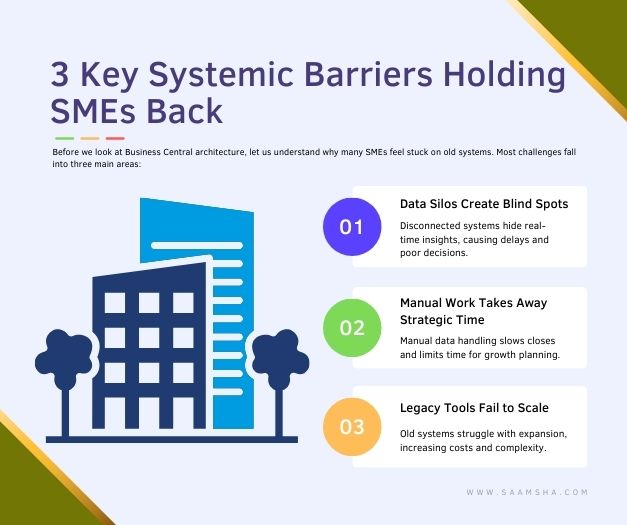
Before we look at Business Central architecture, let us understand why many SMEs feel stuck on old systems. Most challenges fall into three main areas:
- Data Silos Create Blind Spots
Old systems store finance data in one tool, customer details in another, and inventory in a warehouse app.
No one sees the full picture from a single place. Finance waits for month-end updates from operations.
Sales cannot see real-time stock. Supply chain teams place purchase orders without access to cash flow status. This gap leads to delays and poor choices.
- Manual Work Takes Away Strategic Time
When systems do not talk to each other, staff move data into spreadsheets. Invoice match needs manual checks.
Month-end close often involves chasing data from different teams. Inventory checks turn into long, manual tasks.
As per the Ledge 2025 Close Benchmark, 50% of finance teams need 6 or more days to close books. Only 18% finish in 1 to 3 days. This results in less time for growth plans and cost control.
- Legacy Tools Fail to Scale
When a business enters new markets or adds products, old systems hit limits. New entities or currency setup needs IT help.
Infrastructure scale means more server cost. Compliance updates need manual effort. The system created to support a small company turns into a barrier as the business grows.
Four Key Strategic Capabilities Driving Measurable Growth
Business Central turns its architectural advantages into operational strengths that boost SME performance.
- Real-Time Financial Intelligence for Confident Decision-Making
Business Central gives finance leaders complete visibility by unifying accounting, budgets, cash flow, and receivables.
Built-in AI forecasts cash flow, automates reconciliations for faster month-end close, and delivers real-time dashboards with key metrics.
One mid-sized retailer reported 40% faster reporting and closing after implementing the platform.
- Operational Efficiency Through Intelligent Automation
Business Central automates key SME processes, including invoice matching, sales order processing, and production workflows.
AI handles invoices, sales requests, and approvals, reducing errors and freeing staff for higher-value work.
- Supply Chain and Inventory Optimization: Reducing Capital Tied Up in Inventory
Business Central optimizes SME inventory with AI demand forecasting, automated reorder points, and real-time visibility. Vendor performance analytics improve supplier accountability.
One distributor cut inventory costs by 30%, and an SME reduced inventory days from 60 to 45, freeing around $400,000 in cash for growth or debt reduction.
- Customer-Centric Growth Through Unified Customer Intelligence
Business Central gives SMEs a 360-degree customer view, centralizing orders, payments, and communications.
AI-driven personalization suggests products to boost sales, while predictive credit management prevents late payments.
Integration with Dynamics 365 Sales provides real-time inventory and demand visibility, improving coordination, delivery performance, and overall customer satisfaction.
Why 2025 Represents the Critical Moment for SME Modernization?
SME ERP modernization is no longer optional because market realities make it critical. Digital transformation reached 69% of private organizations, and 43% more plan strategies within a year.
Competitors already operate on unified platforms with real-time visibility. Global regulations like GDPR, IFRS 16, and multi-jurisdiction tax rules require strong compliance, which Business Central provides with templates and audit trails.
Modern talent expects cloud platforms with mobile access, making old systems a recruitment disadvantage.
Cloud deployment lets small businesses go live in 2 to 3 months and mid-size companies in 3 to 6 months. Subscription pricing allows SMEs to start small and expand as ROI proves value.
The Implementation Reality: Rapid Deployment Without Operational Disruption
Many SME leaders worry about ERP upgrades due to old failure stories. Business Central changes this picture with a cloud architecture that supports fast and smooth deployment.
Small firms with under 25 users usually go live in 2 to 3 months, and mid-sized teams with 25 to 100 users take 3 to 6 months. Finance can go live first, then other areas follow in phases.
Data migration is safer due to cloud tools and validation checks. Employees already know Excel, Teams and Outlook, so training is lighter and focused on processes.
Final Thoughts
SME leaders often view Dynamics 365 as a way to cut costs by reducing IT staff and software spend. But the real value goes far beyond cost. Business Central acts as a growth driver.
It gives real-time visibility for faster decisions, automates manual work to free teams for strategic tasks, unifies customer data for better service, and scales without infrastructure limits.
The real question is not whether to modernize, but when. Early movers gain a clear competitive advantage.
At Saamsha Technologies, we specialize in modernizing legacy ERP environments, including IBM i–based systems, to Microsoft Dynamics 365 Business Central. Our experts ensure a secure, phased migration with minimal disruption. Talk to us today.