By 2026, ERP will not be limited to data storage. It will act like an intelligent system that supports decisions. In the past, many experts treated ERP as a static digital file room that only showed what happened last month.
As 2026 comes closer, old on-premises ERP systems turn into a burden. In a fast market, a slow response can harm a business. Dynamics 365 provides a key shift for mid-sized enterprises. It moves them away from reactive control and pushes them toward AI-based growth with insight and foresight.
We now enter the era of Autonomous ERP. Software does not wait for user input. It predicts needs, guides next steps, and helps businesses act faster with confidence.
The 2026 ERP Landscape: It is All About “Agency”
The biggest shift for ERP in 2026 will be the move from simple automation to real agency. Traditional automation follows strict rules. If X happens, then do Y. Agentic AI in 2026 goes further.
It suggests actions based on complex and unstructured data. Gartner says that by 2026, about 40% of enterprise apps will include autonomous AI agents. Today, that number stays below 5%.
This change becomes real only in a cloud-first world. Business Central sits at the core of the Microsoft ecosystem and breaks down data silos from legacy ERP systems. In 2026, ERP data must remain open and easily accessible.
You should view it in Teams during a video call, see details in Outlook when a customer sends an email, and check insights in Power BI without manual export. If your ERP needs a VPN to open one invoice, you are already behind.
The true aim is a connected data estate where finance, sales, and operations speak with one voice in real-time.
An outdated ERP can restrict progress. Saamsha Technologies helps you review your data landscape and move toward a scalable Dynamics 365 Business Central solution for smooth operations. Connect with our experts now!
Core Transformation: Copilot and AI-Driven Operations
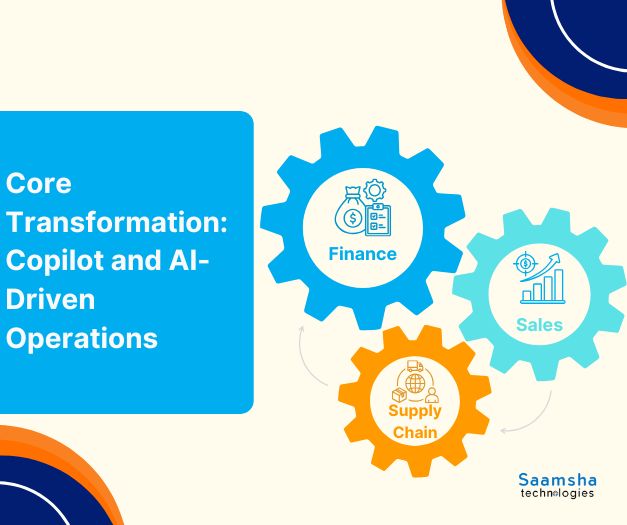
For an experienced leader, the real factor does not lie in a pretty dashboard. It lies at the end of operational friction. This is the space where Microsoft Dynamics 365 Copilot and the new wave of Autonomous Agents redefine productivity.
We now move past smart assistants toward agents that handle heavy work:
- Finance
The Payables Agent can now automate invoice match plus reconciliation with very little human review. This goes far beyond OCR. It uses context-aware logic and reads vendor history and unusual patterns with clarity.
- Sales
AI forecasts no longer depend only on old run rates. It also reads outside signals such as market trends, mail tone and macro indicators. This leads to far better revenue prediction.
- Supply Chain
Predictive stock refill now accounts for lead time variation with accuracy. Recent data shows that 51% of companies that use Copilot report 1% – 10% lower supply chain cost.
When your ERP deals with the routine 80% of tasks, your leaders can devote energy to the strategic 20%. Early users of Copilot in the SMB space already report 6% more net revenue and 20% lower operational cost.
Financial Velocity: From Monthly Closes to Continuous Insight
The Month End Hell, a tense 5-day phase of spreadsheet reconciliation, now feels like history. Business Central supports a Continuous Close approach.
Data posts in real time across the full Microsoft ecosystem, so the CFO no longer plays the role of Scorekeeper. Instead, the CFO steps into the role of Strategic Architect.
Faster execution isn’t just an operational win — it’s a financial one.
Independent analysis from Forrester indicates that companies running on Dynamics 365 Business Central recover their investment in just over a year, largely due to improved visibility, tighter controls, and quicker decisions.
In 2026, a 30-day wait for SKU-level profit insight makes no sense. Modern leaders seek real-time cash flow latency views.
With Business Central, you can open live margin insight in a Tuesday morning meeting rather than waiting for a mid-month board deck. This power shifts finance from a slow report function to a strong competitive weapon.
Scalability Without the “Bloat”
One common fear in the past was ERP bloat. Companies bought a huge and costly system for features they might need someday. Microsoft Dynamics 365 Business Central removes that worry with a composable setup.
You can start with core finance and supply chain modules. Later, you add advanced warehouse tools, service management, or Shopify connectors only when you need them.
This scale-up approach fuels wide adoption. Microsoft recently shared that Business Central now serves more than 40,000 customers, with some reports showing 45,000+ users by late 2025.
Unlike big legacy ERP products that demand costly multi-year upgrades for even small features, Business Central grows with your revenue.
It keeps Total Cost of Ownership close to real business value and helps ROI stay strong through every growth phase.
Implementation: The “Anti-Failure” Framework
Most ERP failures do not happen due to software issues. They happen due to weak change control and scope creep. To achieve strong growth in 2026, leaders must adopt an Anti-Failure mindset.
- Clean Data First
Dirty data kills progress fast. Clean your master data before the move to Business Central starts.
- Fit to Standard Method
Avoid custom code just to copy old and slow processes. Use the standard flow inside Business Central. This keeps future updates from Microsoft in a smooth flow and avoids broken custom work.
- Step-Wise Rollout
Do not attempt a Big Bang start. Go live with finance first, allow it to settle, then roll out operations after that. This lowers shock inside teams and delivers early wins.
From IBM i (AS/400) to Dynamics 365 Business Central
Many mid-sized enterprises still rely on IBM i (AS/400) systems for core finance and operations. While stable, these platforms struggle with real-time analytics, AI-driven forecasting, and ecosystem-level integration.
Dynamics 365 Business Central enables a structured migration path—retaining core business logic while unlocking cloud scalability, Copilot-powered insights, and continuous financial visibility. Saamsha Technologies specializes in bridging this transition with minimal disruption and maximum ROI.
Final Thoughts
Growth in 2026 demands a data-driven ERP. Dynamics 365 helps predict cash flow, reduce manual work and deliver high ROI for modern enterprises.
If your system cannot predict next month’s cash flow, cut half of your manual entry work, or return over 106% ROI, then it is time to consider Microsoft Dynamics 365 Business Central.
The future belongs to automated and agentic businesses. Work with Saamsha Technologies and move to Dynamics 365 Business Central with a solution that grows with your needs.