Migrating vs modernizing IBM i is a critical decision for enterprises running mission-critical workloads. IBM i modernization focuses on addressing immediate and long-term business challenges such as improving operational efficiency, enhancing system integration, and delivering a better user experience.
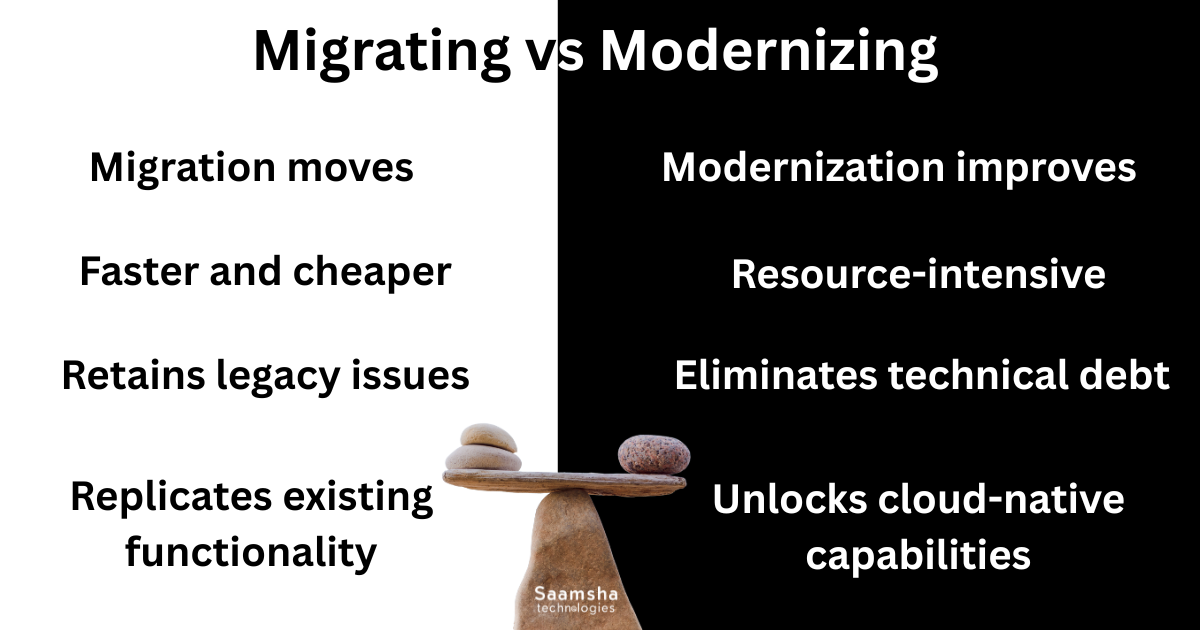
In contrast, migrating IBM i systems to cloud-based infrastructure primarily targets scalability, infrastructure optimization, cost restructuring, and simplified system maintenance. While modernization makes existing IBM i applications more relevant to evolving digital and business requirements, migration concentrates on moving workloads to modern environments without significantly altering application logic.
This blog explains migration vs modernization for AS/400 in detail, helping you determine which approach best supports your business objectives, growth strategy, and long-term technology roadmap.
Migration vs Modernization: Key Differences To Consider for AS/400
Some noticeable differences can help you decide what to choose between IBM i migration and modernization. According to International Data Corporation (IDC), organizations investing in the mainframe platform face 44% reduction in time. The key differences are:
- Operation Flow
- IBM i AS/400 Migration
By transferring your AS/400 workloads to modern cloud infrastructure, you can streamline operations by eliminating on-premise hardware dependencies and improving system availability.
All you need is a stable Local Area Network (LAN) connection that will help you 24/7, and you can increase your business product production or service delivery. Additionally, cloud disaster recovery as a Service(DRaaS) works 10 times faster than standard systems.
- IBM i AS/400 Modernization
IBM i legacy applications followed a monolithic architecture where a single server handled every user request for different services. Therefore, this put an overwhelming load upon the application servers.
Modernization focuses on modularizing applications, enabling APIs, and decoupling business logic, allowing individual components to evolve independently. This approach improves maintainability, enhances operational efficiency, and supports integration with modern enterprise systems.
According to IBM i consulting publications, modernization can improve operational efficiency by up to 10%.
- Scalability
- IBM i AS/400 Migration
For modern IBM i operations, organizations require scalable infrastructure to manage growing volumes of transactional and business data. Migration enables elastic resource allocation, allowing cloud providers to dynamically scale compute and storage resources as demand increases.
This ensures optimized resource utilization, minimizes infrastructure waste, and reduces the risk of performance bottlenecks during peak workloads, supporting business growth without major capital investments.
- IBM i AS/400 Modernization
Legacy IBM i systems often struggle with scalability due to tightly integrated architectures, where even minor changes could impact the entire system. Modernization introduces API-driven and modular application designs, allowing specific components to scale independently without disrupting the broader system.
This enables businesses to respond faster to market changes, improve system flexibility, and support incremental growth more effectively.
- Cost Efficiency
- IBM i AS/400 Migration
IBM i Migration for your business operations into scalable and highly available cloud servers helps to reduce capital expenditures by shifting them to operating expenditures. With cloud providers fully compliant with all requirements, aligning with IBM i features allows you to save your valuable data in their data centers with robust security and encryption.
Therefore, you can focus on other operations, like effective marketing campaigns and streamlining business flows.
- IBM i AS/400 Modernization
Previous AS/400 legacy systems would have skyrocketed business costs in terms of modern digital business operations. They demanded specialized hardware, outdated software versions, and skilled technical people to manage them.
However, IBM i modernization can ensure the leverage of microservice architecture over monolithic architecture. IBM consulting publication reported that modernizing IBM i AS/400 systems reduces maintenance and running costs 30%-50%.
What to Choose Between Migration and Modernization in 2026?
To stay relevant in 2026, you must decide which will increase your business profit. You can consider these key steps to make your choice between IBM i migration and modernization:
- Migration ensures the safe transfer of your business data to a cloud system to maintain continuity, whereas modernization considers governance, architecture, and usage to unlock long-term business value.
- Most of the businesses decide to go with migration, but soon they realize that modernization is the foundation to support systems, like cloud, AI, and analytics.
- Modernization becomes the only thing to do when your system limits scalability, data-quality governance, and provides real-time insights.
- Migration drives you to faster results at low risks and costs when your existing application is compatible with modern tools.
- Many enterprises go for a combined approach using both migration and modernization to align with their business needs to get remarkable results.
- A combined approach, modernizing while migrating, is often the most effective strategy, aligning technical transformation with business outcomes.
The Limitations of IBM i Migration and Modernization
In the section below, include the limitations of both AS/400 migration and modernization:
- IBM i Migration
Here are the migration limitations:
- Complex data structures make it difficult to understand the real information, as the cloud does not always store it in a tabular format.
- Application dependencies sometimes, and compatibility issues of IBM i (AS/400) legacy systems, do not allow to transfer it to the cloud.
- Migrating large transactional workloads sometimes shuts down the business operation, creating a severe business disruption.
The modernization challenges are:
- A shortage of skilled IBM i professionals can impact modernization timelines.
- Integrating modern analytics and AI tools may require incremental application refactoring.
- Change management and process adaptation can pose challenges for organizations modernizing long-standing systems.
Looking for a convenient IBM i solution to increase your business revenue. Then, Saamsha Technologies is an ideal choice for you. We provide consultancy with technical support.
The Bottom Line
In the modern digital age, both modernization and migration of AS/400 can help your business achieve a remarkable position in the market. Migration ensures high and scalable storage at minimal costs, and modernization ensures compatibility gap filling to include modern tools to drive better business outcomes.
However, you should carefully decide which one you must go with to fulfill your business requirements. We recommend adopting a blended approach—migration together with modernization
Partner with Saamsha Technologies to have reliable and cost-efficient IBM i modernization solutions with consultancy and technical support. Our support team is available 24/7 to resolve your queries.