Enterprise Resource Planning (ERP) systems are designed to improve operational efficiency, financial visibility, and decision-making. However, many ERP implementations fail to deliver the expected business value. Organizations often invest heavily in new systems but still face fragmented reporting, inefficient workflows, and low user adoption.
In most cases, the problem is not the ERP platform itself. Solutions like Microsoft Dynamics 365 Business Central provide powerful capabilities for managing finance, operations, and supply chains. The real challenge lies in how the system is implemented. Success depends on proper requirement analysis, disciplined execution, and alignment between technology and business processes.
Primary Factors That Determine Implementation Success
1. Requirement Analysis
Requirement analysis is one of the most critical stages of any Business Central implementation. Without a clear understanding of current workflows, operational bottlenecks, and long-term business objectives, the ERP system cannot be configured effectively.
Many organizations approach requirement gathering as a documentation exercise. However, a successful implementation requires a deeper analysis of how the business actually operates. Finance, procurement, operations, and sales teams must collaborate to map their processes, identify inefficiencies, and define the outcomes they expect from the ERP platform.
When requirements are properly defined, Business Central can be configured to align with real operational needs. This alignment improves financial reporting accuracy, enhances supply chain visibility, and ensures that the ERP system supports business growth rather than limiting it.
Well-structured requirement analysis also reduces implementation delays and prevents costly reconfiguration during later stages of the project.
Actionable Insight:
Insist on process workshops, not just requirement documents. If your implementation partner is not challenging your current processes and identifying opportunities for improvement, they are not adding strategic value to the project.
2. Process Standardization vs. Customization
One of the most common mistakes in ERP implementation is excessive customization. Organizations often attempt to replicate legacy systems or outdated processes within the new ERP platform. While customization may appear to solve short-term operational needs, it often creates long-term complexity.
Business Central is designed with built-in industry best practices and standardized workflows. Leveraging these standard capabilities enables organizations to maintain system scalability, reduce maintenance costs, and adopt future product updates more easily.
Excessive customization can slow system performance, complicate upgrades, and increase dependency on technical resources. In contrast, organizations that adopt a configuration-first approach can implement the system faster while maintaining long-term flexibility.
Standardized processes also improve cross-department collaboration. When finance, operations, and sales teams follow unified workflows, reporting becomes more accurate and decision-making becomes faster.
Actionable Insight:
Ask a simple but powerful question during implementation:
“Is this customization solving a real business problem or just replicating legacy behavior?”
If the customization exists only to preserve old processes, it is likely reducing the long-term value of the ERP system.
3. Implementation Partner Capability
The expertise of the implementation partner plays a major role in determining the success of a Business Central deployment. Even the most advanced ERP platform cannot deliver value if it is implemented without proper technical and functional expertise.
An experienced implementation partner brings structured methodologies, industry knowledge, and practical insights gained from previous ERP deployments. They help organizations avoid common pitfalls, identify process improvements, and ensure that the ERP system is aligned with strategic business goals.
A capable partner also supports long-term system adoption by guiding internal teams through change management, user training, and post-implementation optimization.
What to Evaluate
When selecting an implementation partner, consider these key factors:
- Industry Experience: Understanding of industry regulations, workflows, and operational challenges.
- Functional and Technical Expertise: Ability to align business processes with Business Central capabilities.
- Post-Go-Live Support: Ongoing support to resolve issues and optimize the system.
Choosing the right partner ensures a structured and outcome-driven ERP implementation.
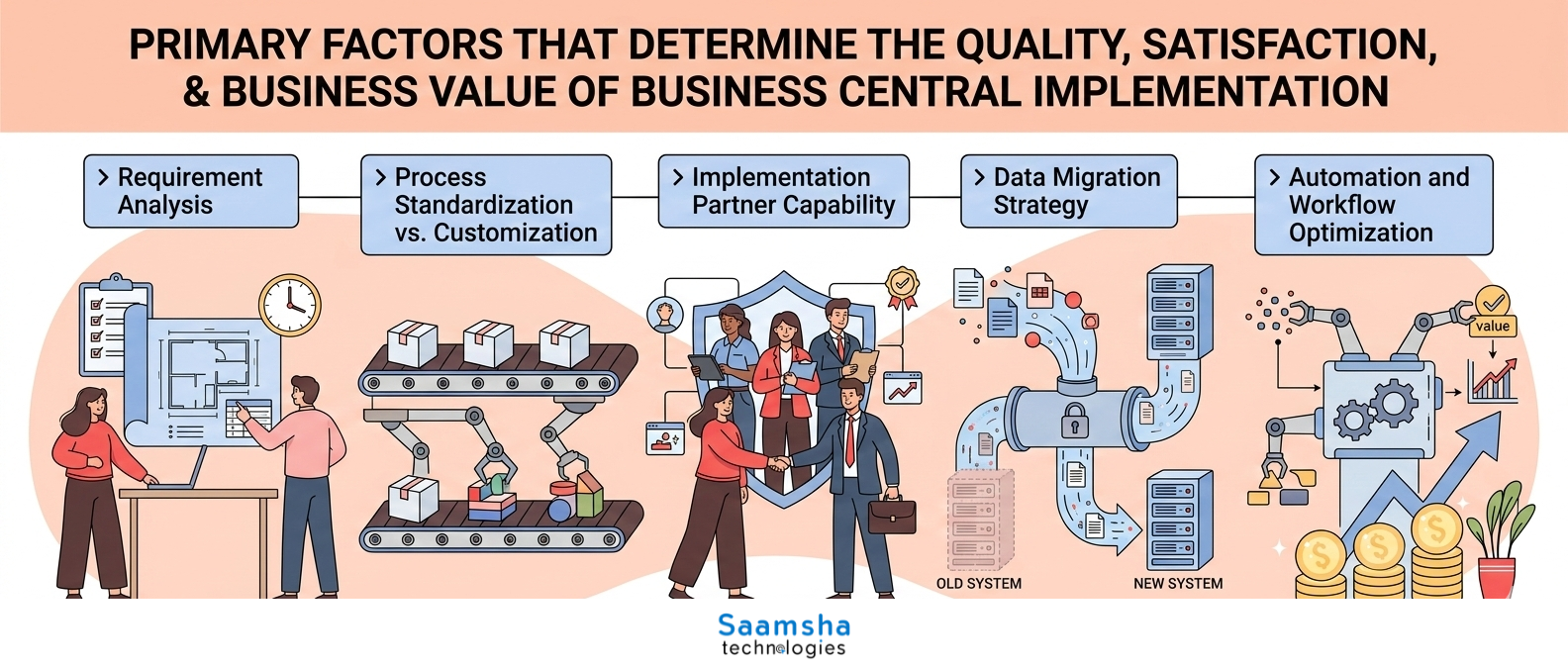
4. Data Migration Strategy
Data migration is often underestimated during ERP implementation, yet it plays a critical role in ensuring reporting accuracy and operational reliability. Migrating inaccurate or incomplete data into a new system can lead to incorrect reports, compliance issues, and poor decision-making.
Legacy systems frequently contain duplicate records, inconsistent entries, and outdated financial data. Without proper validation and cleansing, these issues may carry over into Business Central. A structured migration strategy should identify critical datasets, validate data accuracy, and remove duplicates before transfer.
Actionable Insight:
Treat data migration as a finance-led initiative rather than purely an IT task to ensure financial data accuracy and reliability.
5. Automation and Workflow Optimization
One of the most valuable capabilities of Business Central is its ability to automate routine processes and streamline workflows across departments. Automation reduces manual effort, minimizes human error, and ensures operational consistency.
Business Central supports automated approval workflows, document routing, invoice processing, and inventory management, eliminating repetitive tasks and allowing employees to focus on higher-value activities.
Automation also strengthens compliance and transparency through approval trails and audit records. As a result, organizations benefit from reduced manual work, faster decision-making, lower operational risk, and improved compliance.
By optimizing workflows through automation, businesses can significantly improve productivity and operational efficiency across the organization.
Expected Business Outcomes of a Successful Business Central Implementation
When Business Central is implemented correctly, organizations should experience clear operational improvements. These outcomes represent the true business value of the ERP system.
- Financial Visibility in Real Time
Finance teams gain immediate access to financial performance data, enabling faster reporting and better forecasting.
- Process Standardization Across Departments
Unified workflows ensure consistent operations across finance, procurement, sales, and supply chain teams.
- Reduced Operational Overhead
Automation and streamlined workflows reduce administrative work and operational inefficiencies.
- Faster, Data-Driven Decision-Making
Leadership teams can access real-time dashboards and analytics to make informed strategic decisions.
If these outcomes are not achieved, the ERP implementation may not be delivering its intended value. In such cases, organizations should reassess their implementation strategy and identify gaps that need to be addressed.
Qualified Questions to Ask During Business Central Implementation
Organizations should regularly evaluate their ERP implementation strategy against the factors outlined above. Asking the right questions can reveal whether the project is progressing effectively.
Consider the following questions as you assess your implementation:
- Are your requirements clearly aligned with measurable business outcomes?
- Are you over-customizing the system instead of adopting standardized processes?
- Is your data reliable and properly validated before migration?
- Are your employees fully adopting the system in their daily workflows?
If the answer to any of these questions is unclear, it indicates a gap in the implementation strategy that should be addressed immediately.
Partner with Saamsha Technologies for a Structured Business Central Implementation
Saamsha Technologies combines domain expertise with Microsoft best practices to deliver Business Central implementations that are structured, scalable, and outcome-driven.
Their implementation approach focuses on aligning ERP technology with business objectives, ensuring that organizations achieve measurable operational improvements rather than simply deploying a new system.
By emphasizing requirement analysis, standardized processes, robust data management, and workflow automation, Saamsha Technologies helps businesses unlock the full value of Microsoft Dynamics 365 Business Central.
With the right implementation strategy and expert guidance, organizations can transform ERP from a technical deployment into a powerful platform that drives efficiency, transparency, and long-term business growth.