Building APIs with RPG for modern application needs involves using RPG Open Access (OA) on IBM i (AS/400) to expose legacy business logic as RESTful APIs. This enables seamless integration with web, mobile, cloud, and third-party systems without rewriting core applications. With free-format ILE RPG and enhanced HTTP/JSON capabilities in IBM i 7.6 TR1, organizations can accelerate API-driven transformation while preserving system stability.
Why Build APIs With RPG on IBM i (AS/400)?
Recent data from Fortra’s 2026 IBM i Marketplace Survey confirms that IBM i (AS/400) remains a highly stable and widely used platform.
A major highlight is that 70% of organizations plan to upgrade their hardware or software in 2026, mainly to adopt newer technologies like Power10, Power11, and IBM i 7.6 for better performance, security, and modernization capabilities.
RPG continues to play a central role in this ecosystem. While exact percentages like “93% usage” are often cited informally, the survey clearly shows RPG remains one of the top development languages, supported by modernization features such as free-format syntax, API integration, and open-source compatibility.
At the same time, businesses are not replacing IBM i systems but modernizing them. Many companies still run critical applications on IBM i due to its strong reliability, high ROI, and long-term stability.
Overall, the trend is clear. Instead of full system rewrites, organizations are adopting API-led strategies to expose existing systems and enable faster integrations across digital platforms.
This approach reduces risk, controls costs, and allows legacy systems to support modern web and cloud applications efficiently.
What Makes RPG Open Access Ideal for Modern APIs?
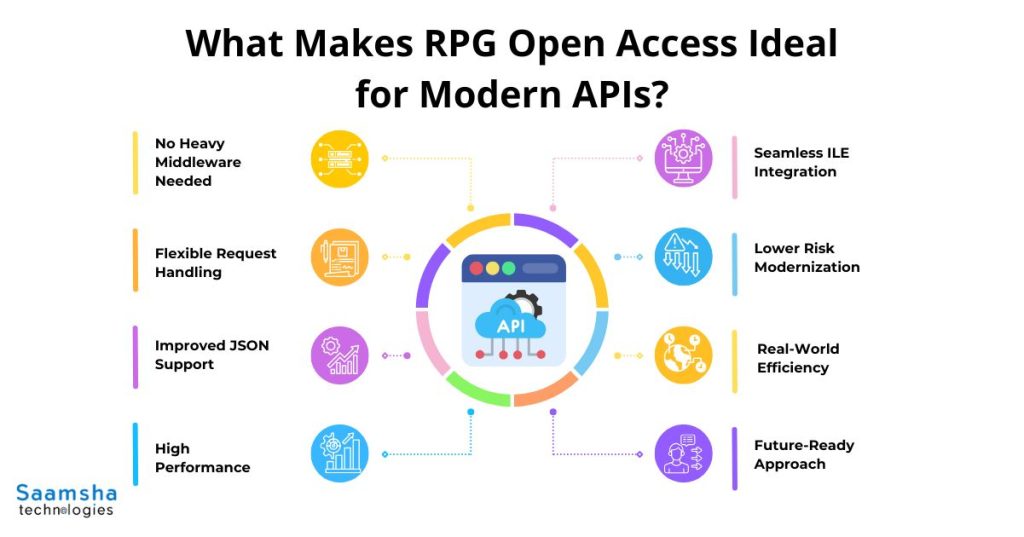
RPG Open Access (OA) is a strong choice for building modern APIs on IBM i because it allows developers to expose business logic without rewriting core applications. Here are other key reasons why it is ideal:
- No Heavy Middleware Needed: It connects RPG programs directly to web interfaces, reducing dependency on external middleware and simplifying overall API architecture.
- Flexible Request Handling: OA does not natively implement HTTP methods but works with handlers that map requests (GET, POST, etc.) to RPG procedures.
- Improved JSON Support: With IBM i 7.6 TR1, built-in functions like %JSON make parsing and generating JSON faster and easier.
- High Performance: Tight integration with DB2 for i ensures efficient data processing with minimal overhead.
- Seamless ILE Integration: Fits naturally into ILE RPG, allowing modular procedures and reusable components.
- Lower Risk Modernization: Enables clean API structures without replacing existing systems, reducing development time and risk.
- Real-World Efficiency: Commonly used for modernizing systems like order tracking and inventory management with high throughput.
- Future-Ready Approach: Provides a practical path to API enablement while preserving the stability of IBM i (AS/400) platforms.
How to Implement a Full REST API in RPG Step-by-Step?
Building a REST API in RPG on IBM i involves creating modular RPG procedures, connecting them to an HTTP server via RPG Open Access, and using SQL with JSON handling for data exchange. Here are the steps:
- Step 1: Create RPG Module: Write an ILE RPG program using free-format syntax. Define procedures that will act as API endpoints (e.g., customer lookup, order retrieval).
- Step 2: Compile and Bind: Compile the RPG code into modules and bind them into a *SRVPGM (service program) for reuse and modular design.
- Step 3: Configure HTTP Server: Set up the Apache HTTP Server on IBM i (AS/400) to route incoming API requests to your RPG program or handler.
- Step 4: Connect via RPG Open Access (OA): Use OA handlers to pass HTTP request data (URL, query parameters, request body) into RPG procedures.
- Step 5: Implement Business Logic: Use embedded SQL to fetch, insert, or update data in DB2 for i based on the API request.
- Step 6: Handle JSON Data: Parse incoming JSON and generate responses using built-in functions like %JSON.
- Step 7: Validate Input (POST/PUT): Check request data before processing to ensure data accuracy and security.
- Step 8: Add Error Handling: Return proper HTTP status codes and log errors using job logs or temporary libraries.
- Step 9: Test APIs: Use tools like Postman to test endpoints and verify responses.
- Step 10: Optimize and Scale: Refine performance and reuse procedures to support scalable, production-ready APIs.
Transform legacy AS/400 data into fast, secure RESTful services without costly rewrites. With free-format ILE RPG and IBM i 7.6 TR1 enhancements, you get seamless web, mobile, and cloud integration. Saamsha Technologies specializes in IBM i (AS/400) modernization. Contact us now.
How to Master JSON Handling and Security in RPG APIs?
Modern RPG APIs combine efficient JSON handling, strong security practices, and high system reliability.
By leveraging built-in functions, external tools, and IBM i (AS/400) enhancements, developers can build secure, scalable, and high-performance enterprise-grade API solutions.
- JSON Handling: Built-in %JSON in RPG supports parsing and generating structured data (arrays, nested objects, decimals).
For larger payloads, libraries like Scott Klement’s YAJL are commonly used, though exact size limits depend on system configuration.
- Secure Communication: Enforcing HTTPS is standard practice on IBM i. JWT-based authentication can be implemented, while OAuth2-based authentication and API gateway integrations can further strengthen enterprise-level API security.
- Rate Limiting: Developers often use data queues or custom counters to control API traffic and prevent abuse.
- Security Enhancements: Updates around IBM i 7.6 include stronger encryption and security features, helping reduce vulnerabilities.
- Best Practices: Using parameterized SQL queries helps prevent SQL injection, while RBAC improves access control.
- Reliability: IBM i (AS/400) systems are widely known for high uptime and stability in enterprise environments.
Final Takeaway
Modern RPG API development focuses on performance, scalability, and practical modernization rather than full system replacement. Techniques like reducing database hits through optimized data structures, array processing, and caching help improve response times, while tools like NGINX enable secure and efficient API exposure.
IBM Power systems and recent IBM i (AS/400) enhancements continue to strengthen scalability and processing efficiency, especially when combined with performance monitoring tools.
Developers commonly use RDi for development and Postman for testing, along with JSON libraries for advanced data handling. Overall, API-driven RPG development enables businesses to modernize legacy systems, accelerate integrations, and deliver digital services without disrupting core operations. Native RPG-based APIs often outperform layered solutions due to lower overhead and tighter system integration.
Looking ahead, combining RPG with OpenAPI standards and modern UI frameworks allows businesses to scale globally while preserving the reliability of their core systems.
Partner with Saamsha Technologies to unlock the full potential of your AS/400 systems, faster integrations, scalable APIs, and zero disruption to core operations. Contact our experts now!