API keys enable secure communication between IBM i (AS/400) systems and IBM Cloud. They act as unique identifiers that verify every request. This ensures only authorised users and applications can access data.
For businesses using an AS400 Application , API keys connect legacy platforms with modern cloud services safely.
As more companies adopt hybrid cloud, secure integration becomes essential. According to IBM, over 77% of enterprises use hybrid cloud strategies.
API keys protect sensitive data during these interactions. They ensure reliable and secure data exchange in IBM i (AS/400) environments.
What Are API Keys and Why Are They Critical for IBM i (AS/400) Integrations?
API keys are long, encrypted alphanumeric tokens that authenticate and authorize applications, rather than users, when interacting with IBM i (AS/400) systems.
They function as secure digital credentials enabling controlled, machine-to-machine communication across modern and legacy environments.
- Unique Identification: Each API key is tied to a specific application, client, or integration partner.
- Authentication & Authorization: Validates requests without exposing sensitive IBM i user credentials.
- Secure Modernization: Enables web, mobile, and cloud apps to access IBM i data without direct database exposure.
- Machine-to-Machine Communication: Supports automated workflows such as order processing, billing, and inventory synchronization.
- Usage Monitoring: Tracks API consumption, detects anomalies, and enforces rate limits.
- Attack Surface Reduction: Minimizes risks like credential leaks, injection, and broken object-level authorization (BOLA).
- Safe Storage Practices: Keys should be stored in environment variables or vaults, not hardcoded in applications.
- Auditability & Compliance: Unique keys enable precise logging in compliance with regulatory standards such as GDPR or HIPAA.
- Legacy System Protection: Secures API wrappers (e.g., Java/Python) that invoke RPG/COBOL logic.
- Enhanced Security Stack: Works with OAuth, MFA, and IBM i tools like Exit Programs and Authority Collection for layered defense.
How Do API Keys Enable Secure Access Between IBM i (AS/400) and IBM Cloud?
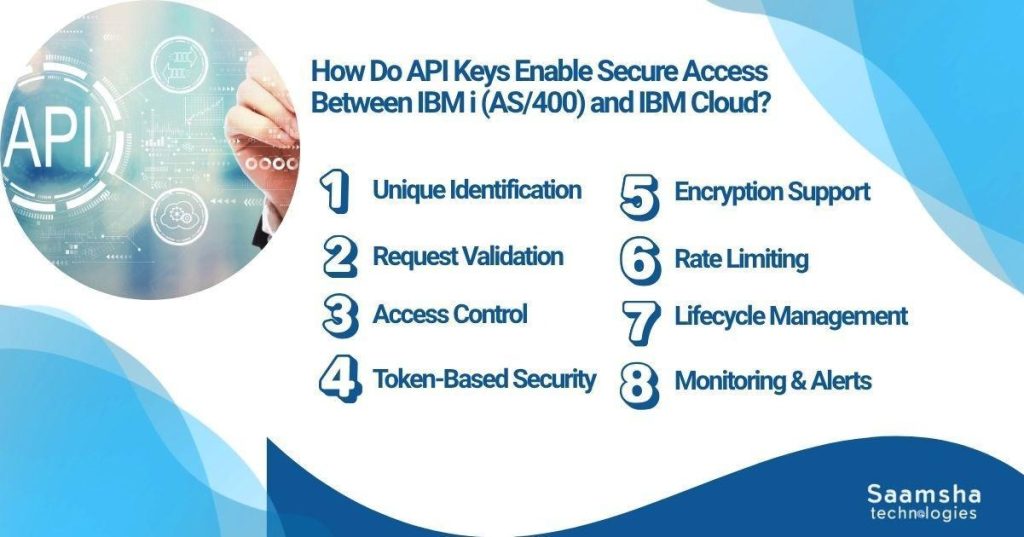
API keys enable secure access between IBM i (AS/400) and IBM Cloud by acting as unique digital credentials that authenticate every request, restrict access to authorised systems, and safeguard sensitive enterprise data across hybrid environments.
- Unique Identification: API keys uniquely identify applications connecting IBM i workloads to cloud APIs.
- Request Validation: Every API call is authenticated before data exchange begins.
- Access Control: Prevents unauthorised access and limits exposure of legacy systems.
- Token-Based Security: Replaces basic authentication with more secure, revocable credentials.
- Encryption Support: Works with TLS (e.g., TLS 1.3) to secure data in transit.
- Rate Limiting: Controls API usage per key to mitigate abuse and DoS risks.
- Lifecycle Management: Integration with tools like IBM API Connect enables key rotation and governance.
- Monitoring & Alerts: Enables real-time tracking and threat anomaly detection.
Why Do IBM i (AS/400) Systems Need Secure Cloud Connectivity Today?
IBM i (AS/400) systems need secure cloud connectivity to modernize legacy operations while protecting sensitive data from evolving cyber threats. As APIs and hybrid architectures expand, strong security controls are essential to maintain reliability and compliance.
- Rising Cyber Threats: Ransomware, API attacks, and identity-based breaches are increasing, with incidents often exploited within minutes of vulnerability disclosure.
- Zero Trust Security Model: Secure connectivity enables strict identity verification, network segmentation, and continuous monitoring.
- Encrypted Data Transmission: Protocols such as SSL/TLS and VPNs protect sensitive data (e.g., financial and healthcare) in transit.
- Hybrid IT Enablement: Supports integration between on-prem IBM i workloads and cloud platforms for AI, analytics, and scalability.
- API-Driven Integration: Secure gateways allow legacy RPG/COBOL applications to connect with modern web and mobile systems.
- AI-Powered Monitoring: Integration with SIEM tools enables real-time anomaly detection and faster incident response.
- Business Continuity: Cloud-based backups, geo-redundancy, and disaster recovery minimize downtime risks.
- Cost and Scalability Benefits: Enables pay-as-you-go models, reducing CapEx and improving resource flexibility.
How Does Saamsha Technologies Enhance IBM i (AS/400) API Security and Integration?
Saamsha Technologies enhances IBM i (AS/400) API security and integration by combining API keys with OAuth 2.0 and TLS 1.3 to establish secure, scalable communication between legacy systems and modern cloud platforms. This layered approach protects sensitive data while enabling seamless hybrid connectivity.
Their API enablement framework enforces strict access controls, AES-256 encryption, and real-time monitoring to detect anomalies and prevent threats such as shadow APIs and unauthorized access. Integration with DevOps practices further ensures secure, automated deployments and faster release cycles.
Beyond security, Saamsha Technologies drives modernization through RPG refactoring, DB2 upgrades, and UI transformation, allowing organizations to modernize interfaces and workflows without altering core business logic, ensuring stability alongside innovation.
Final Takeaway: Why API Keys Are Essential for IBM i (AS/400) Cloud Security
API keys are set to become foundational to IBM i (AS/400) cloud security as hybrid architectures deepen and threat landscapes intensify.
Their evolution is closely tied to Zero Trust models, where every API call is continuously verified, context-aware, and tightly scoped.
As AI-driven monitoring matures, API keys will integrate with intelligent security systems to detect anomalies in real time, drastically reducing response windows for emerging threats such as supply-chain exploits.
Looking ahead, API keys will also align with quantum-resistant encryption standards, ensuring long-term protection of sensitive enterprise data.
Their role will expand beyond access control to enable autonomous integrations, power AI, IoT, and high-volume transactional systems without compromising governance.
As platforms like IBM PowerVS and AI ecosystems scale, API key-based security will underpin resilient, compliant, and future-ready IBM i (AS/400) environments.